2026-07-10 11:43:11
A low-GWP battery test chamber helps EV, ESS and lithium-ion battery laboratories reduce long-term dependence on high-GWP refrigerants while still providing the controlled temperature or temperature-humidity environment needed for testing. For European and U.S. labs, the discussion should not stop at "which refrigerant is greener." The better question is whether the chamber can meet the real battery heat load, fit the installation site, support service over its life cycle and align with current low-GWP refrigerant planning.
For suitable projects, Climate Chambers with CO2 Refrigerant (R744) can be considered as part of this strategy. The final choice still depends on test profile, battery format, cooling capacity, humidity requirements and local service conditions.
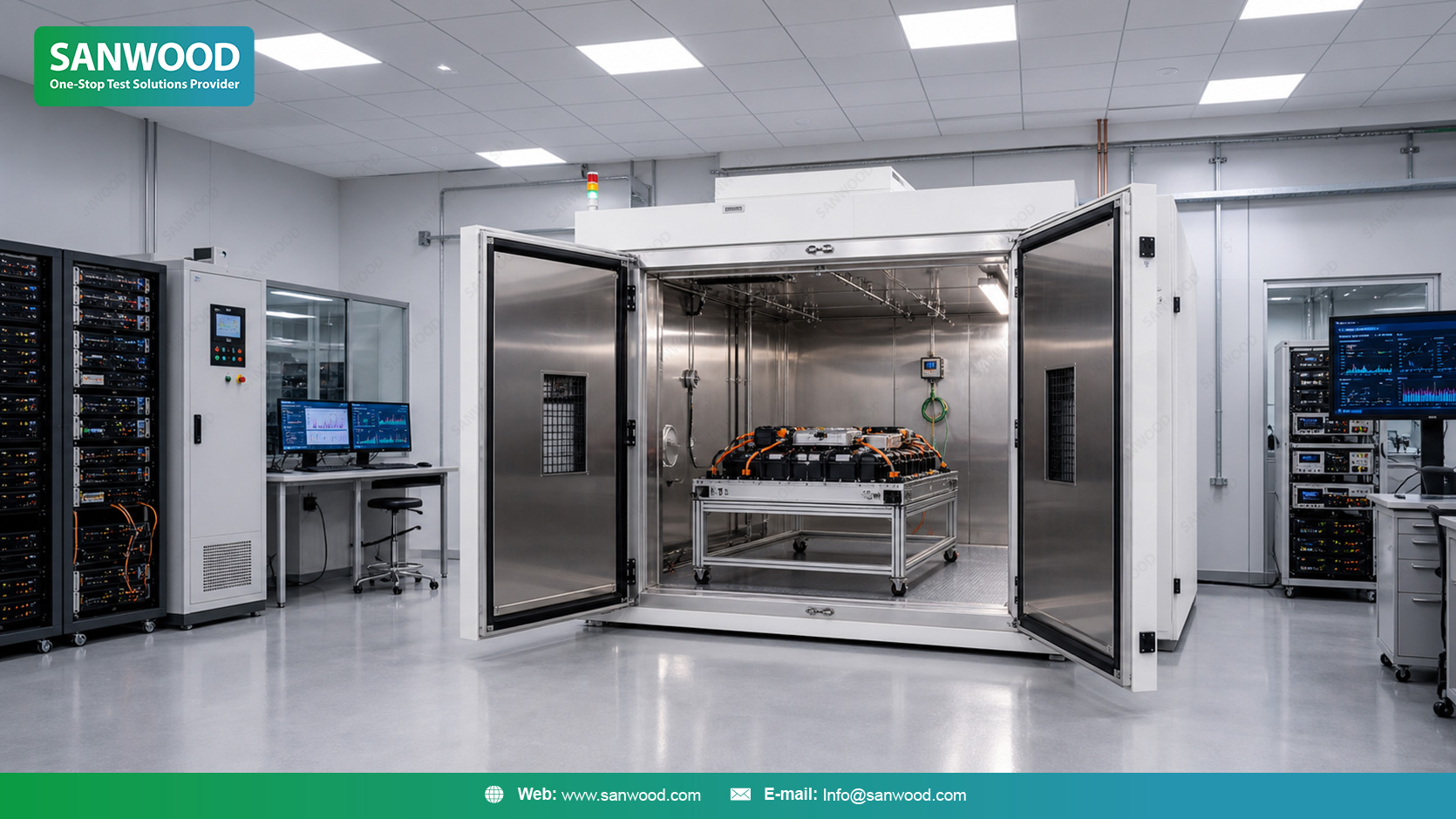
When a battery laboratory plans new test capacity, the first conversation is usually practical: chamber size, temperature range, humidity range, ramp rate, cable ports and delivery time. That is still the right starting point. A chamber that cannot hold the test condition is not useful, no matter how attractive its refrigerant strategy looks.
But for European and U.S. projects, another question is now moving into the same meeting:
What will this chamber be like to own five, eight or ten years from now?
That question changes the selection process. Battery test chambers are not short-life accessories. A walk-in chamber for EV packs, an environmental test chamber for ESS modules or a climatic test chamber for battery aging may remain in daily service across several battery programs. During that time, refrigerant regulations, customer audits, internal ESG requirements and service costs can all change.
This is why low-GWP battery test chambers are becoming more relevant. The topic is also uptime, serviceability and procurement risk.
The European Union has strengthened its fluorinated greenhouse gas framework through Regulation (EU) 2024/573. In the United States, the EPA implements HFC reduction programs under the American Innovation and Manufacturing Act. These policies push the market toward lower-impact refrigerants and better refrigerant management.
For a battery testing lab, that does not mean every new chamber must have the same refrigeration design. It means refrigerant choice should be part of early specification. If the team leaves it until the final quotation stage, the project may already be locked into a chamber platform that does not fit long-term planning.
A useful low-GWP discussion connects three areas:
• The regulatory and corporate direction in the lab's region
• The actual battery test conditions, including heat load
• The supplier's ability to install, commission and support the chamber
A brochure may say "low GWP," but engineers still need to know what happens at low temperature with an active battery pack inside the chamber.
CO2 is commonly used as the reference gas for global warming potential, and R744 is the refrigerant name for CO2. That makes CO2 / R744 attractive for laboratories trying to reduce the climate impact of refrigeration systems.
For environmental test chambers and climatic test chambers, R744 can be a strong direction when the project requirements match the technology. Climate Chambers with CO2 Refrigerant (R744) may be suitable for battery reliability testing, temperature cycling and long-duration aging where low-GWP refrigeration is part of the equipment strategy.
The important word is "suitable." CO2 refrigeration has its own system design requirements: pressure management, component selection, control logic, heat rejection, service access and safety of the refrigeration circuit. R744 should not be treated as a simple replacement name printed on the quotation.
Before choosing a CO2 refrigerant battery test chamber, the lab should confirm:
• Required temperature range and time at extreme setpoints
• Whether humidity control is needed
• Battery format: cell, module, pack, ESS rack or BESS cabinet
• Maximum sample heat load during charge-discharge operation
• Cable port quantity, size and location
• Ambient conditions around the installation site
• Local service capability and spare parts support
Battery testing is not the same as testing an empty metal block. A battery pack can generate heat during cycling. Cables and current connections add thermal and mechanical constraints. In some low-temperature discharge tests, the refrigeration system must remove heat while the chamber is also trying to hold a difficult setpoint.
This is where empty-chamber data can mislead a project team.
A chamber may show a good temperature range in the catalog. But if the real application involves a high-energy module or pack generating heat inside the workspace, cooling capacity at that setpoint becomes more important than the headline range.
For low-GWP battery test chamber selection, heat load should be discussed before model confirmation. The lab should provide battery size, mass, voltage, current, cycling profile, expected heat release and test duration.
European and U.S. labs do not operate under identical rules. Still, the procurement logic is moving in a similar direction: choose equipment that supports battery testing today without creating avoidable refrigerant risk later.
Decision Area | European Lab View | U.S. Lab View | What to Ask the Chamber Supplier |
Refrigerant planning | EU F-gas rules make low-GWP planning visible in procurement | HFC phasedown programs influence future refrigerant availability and service practice | Which refrigerant options are available for this chamber size and temperature range? |
Long-term ownership | Customer and corporate sustainability reviews may be strict | ESG, state-level expectations and customer audits may affect lab decisions | How will the chamber be serviced over its expected life? |
Battery heat load | EV and ESS validation often runs long and hot | Pack, module and grid-storage tests can require high uptime | What cooling capacity is available at the required test setpoint with active samples? |
Installation | Site planning may include ventilation, utilities and service access | Lab expansion often requires coordination with cyclers and monitoring systems | What must be prepared before delivery and commissioning? |
Safety | Battery risk and environmental performance may be reviewed together | Lab safety procedures and equipment procurement often overlap | Which safety features are included, and which require project review? |
This comparison is not a legal conclusion. It is a way to ask better engineering questions before purchase.
Low-GWP refrigeration is one part of chamber selection. It should not hide the basic test requirement. A lab testing small cells does not have the same needs as a team testing a full EV battery pack.
Test Requirement | Product Direction to Review | Practical Note |
Low-GWP environmental testing | Climate Chambers with CO2 Refrigerant (R744) | Best discussed when the lab wants low-GWP planning and controlled temperature or humidity testing |
Active charge-discharge testing | Review cycler integration, cable routing and heat load | |
EV pack or ESS pack testing | Confirm floor loading, chamber volume, airflow and service access | |
Liquid-cooled battery validation | Coordinate coolant loop, battery operating mode and chamber profile | |
Multi-sample or higher-throughput testing | Dual-Layer Battery Test Chamber or Triple-Layer Battery Test Chamber | Useful when independent zones or sample throughput matter |
Higher-risk lithium-ion scenarios | Safety configuration must be based on project risk assessment | |
Complete battery test planning | Connect cell, module, pack and system-level requirements before selecting equipment |
First define the test. Then decide whether low-GWP refrigeration, R744 technology or another chamber configuration fits the project.
One point deserves a clear line: low-GWP refrigeration does not replace battery safety design.
If a test involves venting, abuse conditions, high-energy packs, abnormal charging or potential thermal runaway, the chamber discussion must include risk assessment. Exhaust, interlocks, monitoring, pressure relief concepts and explosion-proof design may need review.
No chamber should be described as preventing thermal runaway. A chamber can help provide a controlled space and project-specific safety functions.
For many laboratories, this creates two parallel tracks:
• Low-GWP refrigeration planning for long-term environmental responsibility
• Battery safety planning for the expected test risk
Both tracks matter, but they are not the same thing.
SANWOOD supports New Energy Batteries Testing projects by reviewing the actual test scenario before recommending a chamber. For European and U.S. labs, that review can include low-GWP refrigerant direction, but it also covers the details that decide whether the chamber will perform correctly in daily use.
Typical review items include battery format, sample quantity, heat load, temperature range, humidity requirement, test duration, charge-discharge profile, cable ports, airflow, safety configuration, installation space, power supply, ventilation and maintenance access.
For a lab considering CO2 / R744, SANWOOD can evaluate whether Climate Chambers with CO2 Refrigerant (R744) fit the required test profile. If the project is more focused on pack testing, SANWOOD may review Walk-In Battery Pack Test Chamber options. If the sample generates significant heat during cycling, Battery Charge-Discharge Test Chamber configuration may be more relevant. For liquid-cooled systems, Liquid-Cooled Battery Test Chamber planning can be included. For higher-risk testing, Explosion-Proof Battery Test Chamber design should be discussed separately from the low-GWP refrigerant decision.
The goal is to help the lab avoid a mismatch between refrigerant strategy, battery test requirement and long-term operation.
It is a battery environmental test chamber or climatic test chamber designed with a refrigerant strategy that reduces reliance on high-GWP refrigerants. CO2 / R744 is one option for suitable chamber designs.
No. R744 can be a strong low-GWP direction, but suitability depends on temperature range, cooling capacity, humidity control, battery heat load, installation conditions and service planning.
European F-gas rules and U.S. HFC phasedown programs are changing how laboratories think about refrigerant risk, equipment ownership and future serviceability.
It may be possible, but the chamber must be reviewed around pack size, heat load, airflow, floor loading, cable routing and test duration. A Walk-In Battery Pack Test Chamber should be selected by project requirements, not refrigerant preference alone.
Low-GWP refrigeration and battery abuse safety are separate decisions. If the test risk is high, the lab should review safety configuration and may need an Explosion-Proof Battery Test Chamber based on the project risk assessment.
Low-GWP battery test chambers are becoming part of serious laboratory planning in Europe and the United States. The reason is not only regulation. It is the reality that battery test chambers are long-term assets, and refrigeration strategy can affect serviceability, sustainability review and procurement confidence over time.
For EV, ESS, BESS and lithium-ion battery testing, the right decision starts with the test profile: battery format, heat load, temperature range, humidity requirement, safety risk and installation conditions. Once those details are clear, the lab can decide whether Climate Chambers with CO2 Refrigerant (R744), a Walk-In Battery Pack Test Chamber, a Battery Charge-Discharge Test Chamber or another SANWOOD solution is the right direction.
Contact SANWOOD Technology to discuss a low-GWP battery test chamber solution for your European or U.S. battery testing laboratory.
Sanwood is not just a company; it is a commitment to delivering high-quality products that stand the test of time.

 English
 中 文
中 文


 info@sanwood.com