2026-07-09 09:10:21
As environmental testing laboratories prepare for stricter sustainability expectations and long-term refrigerant availability challenges, refrigeration design is becoming a key factor in equipment selection.
R744, also known as CO2 refrigerant, is gaining attention because carbon dioxide has a Global Warming Potential of 1. For laboratories using environmental test chambers, this makes R744 an important option when low-GWP design, regulatory planning, and long service life are part of the purchasing decision.
But R744 is not simply a drop-in replacement for conventional refrigerants. It brings clear environmental advantages, while also requiring careful engineering around pressure, system design, efficiency, safety, and maintenance.
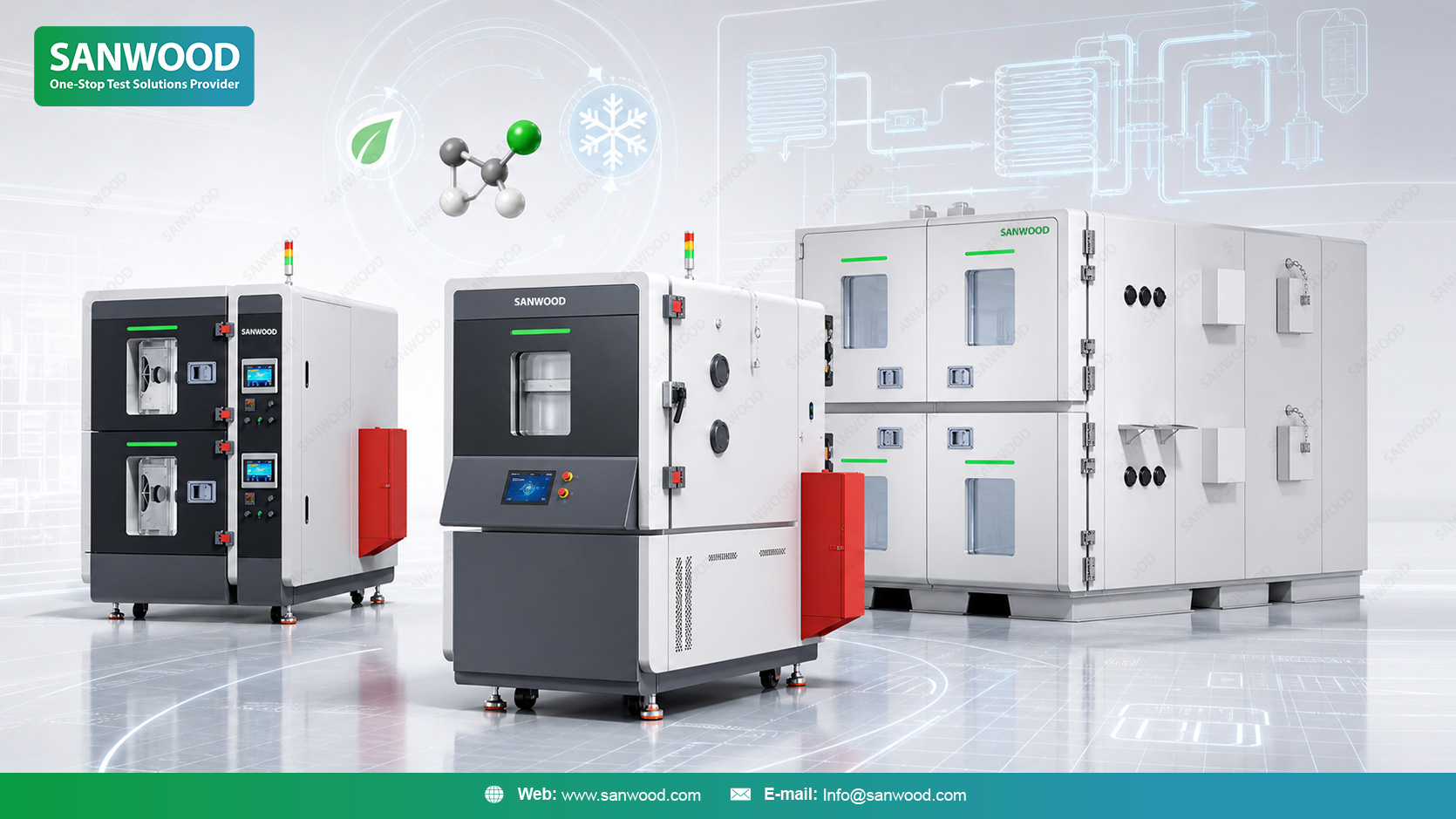
R744 is the refrigerant name for carbon dioxide used in refrigeration systems. Because CO2 is the reference gas for Global Warming Potential, it has a GWP value of 1.
For test chamber applications, this makes R744 attractive for projects where customers want to reduce dependence on high-GWP refrigerants. It can be considered for climatic test chambers, temperature humidity chambers, thermal cycling chambers, and battery testing chambers, depending on the required temperature range and cooling load.
R744 refrigeration is especially relevant for European laboratories and multinational manufacturers that need to consider F-gas reduction, corporate sustainability targets, and long-term maintenance planning.
Refrigeration is one of the most important systems inside an environmental test chamber. It determines low-temperature performance, pull-down speed, stability, recovery after door opening, and reliability during long-duration testing.
For laboratories, R744 CO2 refrigeration can support several strategic goals:
Lower direct climate impact from refrigerant leakage
Better alignment with low-GWP procurement policies
Reduced long-term risk from high-GWP refrigerant restrictions
Stronger sustainability story for laboratory investment
Improved future readiness for European and global projects
For temperature humidity test chambers, the refrigerant choice also affects humidity control, defrosting strategy, compressor selection, and long-term service planning.
The main advantage of R744 is its very low GWP. For laboratories trying to reduce the climate impact of testing infrastructure, this is often the starting point.
R744 also has useful thermal properties for refrigeration design. In the right system architecture, it can provide strong cooling capacity and stable performance for demanding test programs.
For environmental testing equipment, the benefits may include:
GWP=1 refrigerant strategy
Reduced reliance on high-GWP HFC refrigerants
Good fit for low-GWP equipment procurement
Potential long-term refrigerant availability advantage
Suitable for custom chamber engineering
Useful for European laboratory and automotive testing projects
These benefits are strongest when the entire chamber is designed around R744, not when the refrigerant is treated as an isolated component.
R744 refrigeration operates at significantly higher pressure than many conventional refrigerants. This requires proper component selection, pressure-rated piping, safety valves, controls, and qualified refrigeration engineering.
Before selecting R744 for a battery environmental test chamber or general environmental chamber, engineers should evaluate:
Required temperature range
Cooling rate and heat load
Chamber volume and airflow design
Ambient temperature at the installation site
Humidity control requirements
Defrosting strategy
Compressor and heat exchanger design
Pressure protection and service access
Local technician familiarity with CO2 refrigeration
R744 can be a strong choice, but it must be matched to the real test profile. A chamber for steady low-temperature storage may require different refrigeration design than a chamber used for rapid temperature cycling or battery charge-discharge testing.
Battery testing creates special refrigeration challenges. EV batteries, ESS modules, and BESS battery packs can generate heat during charge-discharge cycling, and the chamber must maintain stable environmental conditions while managing that heat load.
For walk-in battery pack test chamber, R744 refrigeration may be considered when the project requires low-GWP design and large-capacity cooling. However, battery testing also brings additional safety requirements, including cable ports, monitoring, airflow uniformity, emergency protection, and test risk assessment.
Typical applications include:
EV battery pack environmental testing
ESS and BESS reliability testing
Lithium battery temperature cycling
Battery charge-discharge testing under controlled temperature
Automotive component climatic testing
Long-duration storage and aging tests
For battery-related projects, refrigeration design should be evaluated together with chamber safety configuration, battery heat load, and test procedure.
Low GWP is important, but it should not be the only selection factor. R744 may not be ideal for every test chamber project.
A different refrigeration design may be more suitable when:
The chamber requires extremely specific ultra-low-temperature performance
The installation site has limited service support for CO2 systems
Project cost is more important than long-term refrigerant strategy
Existing facility infrastructure is not suitable for the required pressure and safety design
The test profile is better served by another low-GWP or cascade refrigeration solution
The right choice depends on the balance between environmental goals, test performance, serviceability, cost, and risk.
SANWOOD can support low-GWP refrigeration discussions for custom environmental testing equipment, including R744 CO2 refrigeration options where they match the project requirements.
For each project, chamber design should be reviewed based on temperature range, humidity range, chamber size, sample heat load, airflow uniformity, safety requirements, control accuracy, and installation conditions.
SANWOOD solutions can include:
Environmental test chambers
Climatic test chambers
Temperature humidity test chambers
Battery environmental test chambers
Walk-in battery pack test chambers
Custom low-GWP refrigeration test chambers
The final refrigeration design should be confirmed according to the test method, site conditions, service plan, and customer operating requirements.
Before choosing an R744 CO2 refrigeration system, ask these questions:
What temperature range and cooling rate are required?
Is humidity control part of the test program?
What is the sample heat load?
Will the chamber be used for battery charge-discharge testing?
Is the chamber cabinet type or walk-in type?
Does the site have suitable ventilation and service access?
Are technicians available for CO2 refrigeration maintenance?
What safety devices are included for high-pressure refrigeration?
How does R744 compare with other low-GWP options for this project?
A clear specification at the beginning helps avoid performance gaps after installation.
R744 CO2 refrigeration gives environmental test chamber users a practical path toward low-GWP equipment design. Its GWP=1 profile makes it especially relevant for European laboratories, battery testing facilities, automotive suppliers, and manufacturers with sustainability-driven procurement requirements.
However, R744 is an engineering choice, not just an environmental label. The best results come from matching refrigerant strategy with chamber performance, pressure-rated design, safety protection, service capability, and the real testing workload.
R744 is the refrigerant name for carbon dioxide used in refrigeration systems. CO2 has a GWP of 1.
It can help reduce dependence on high-GWP refrigerants and support low-GWP equipment planning, especially for European and sustainability-focused projects.
Not always. Suitability depends on temperature range, cooling capacity, humidity control, chamber size, test profile, and service conditions.
Yes, it can be considered for battery environmental testing projects, including EV, ESS, and BESS testing, when the system is engineered for the heat load and safety requirements.
R744 systems operate at higher pressure than many conventional refrigeration systems, so pressure-rated design and safety protection are essential.
No. Laboratories should also evaluate performance, energy efficiency, maintenance, site conditions, technician availability, and total lifecycle cost.
SANWOOD can discuss R744 CO2 refrigeration options according to project requirements, test conditions, chamber size, and installation environment.
Sanwood is not just a company; it is a commitment to delivering high-quality products that stand the test of time.

 English
 中 文
中 文



 info@sanwood.com