2026-07-07 11:28:12
For European battery testing laboratories, the refrigeration system inside a battery test chamber is no longer just a technical detail. It is becoming part of long-term compliance planning, sustainability reporting, procurement evaluation, and service risk management.
As EV batteries, ESS batteries, and lithium-ion modules require more environmental and climatic testing, laboratories need test chambers that can deliver stable low-temperature performance while reducing dependence on high-GWP refrigerants. This is where GWP=1 becomes important.
GWP means Global Warming Potential. It measures how much heat a greenhouse gas can trap in the atmosphere compared with carbon dioxide over a defined time period. Carbon dioxide is used as the reference gas, so CO2 has a GWP of 1.
In refrigeration, a lower GWP value generally means a lower climate impact if refrigerant leakage occurs. For environmental test chambers, climatic test chambers, temperature humidity test chambers, and thermal cycling chambers, this matters because refrigeration systems often operate under demanding cycle conditions and long running hours.
Europe has been moving strongly toward reducing fluorinated greenhouse gases, commonly known as F-gases. The current EU F-gas framework, Regulation (EU) 2024/573, continues the reduction of high-GWP refrigerants and supports the transition toward climate-friendly alternatives.
For testing laboratories, this affects more than environmental policy. It can influence:
Equipment purchasing decisions for battery test chambers and environmental testing equipment
Refrigerant availability and future maintenance cost
Service planning for long-life laboratory assets
Corporate sustainability reporting and customer audits
Supplier qualification for EV, ESS, and BESS battery testing projects
A battery test chamber is usually a long-life asset. Choosing a low-GWP refrigeration solution helps laboratories avoid buying equipment that may become harder or more expensive to maintain during its service life.
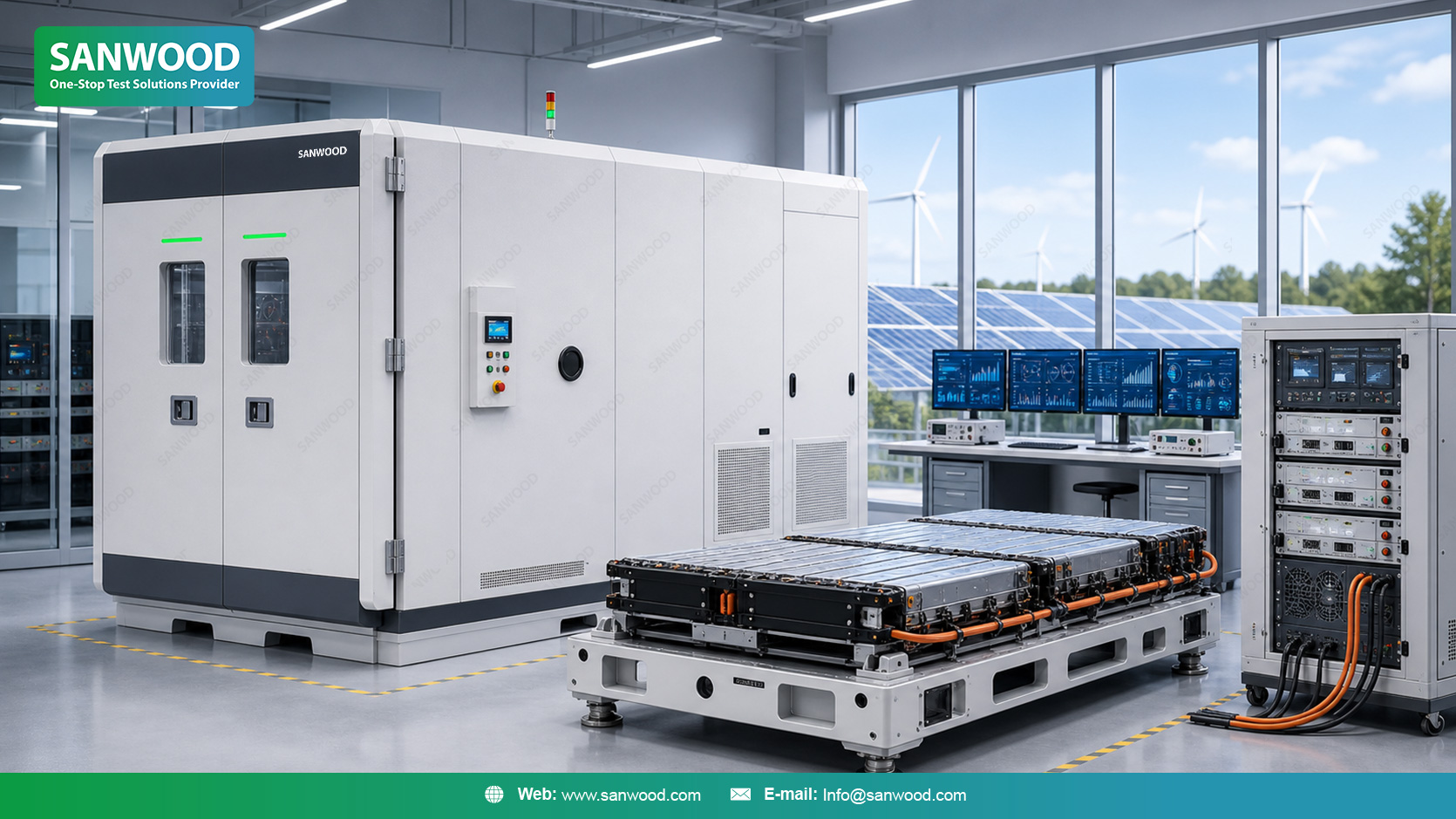
Battery environmental test chambers need strong refrigeration performance. EV battery pack test chambers, lithium-ion cell chambers, module chambers, and walk-in battery pack test chamber are often used for low temperature, high temperature, temperature cycling, humidity, storage, and charge-discharge conditions.
These tests can create heavy thermal loads, especially when batteries are connected to charge-discharge equipment. A stable refrigeration system is essential for test accuracy, repeatability, and chamber reliability.
For European laboratories, GWP=1 refrigeration can support three goals at the same time:
Lower environmental impact from refrigerant leakage
Better alignment with European low-carbon procurement expectations
More future-ready service and compliance planning
In many industrial refrigeration applications, CO2 refrigerant is also known as R744. Because CO2 is the reference gas for GWP calculation, R744 has a GWP of 1.
For battery test chambers, CO2/R744 refrigeration can be considered when customers need low-GWP design, European project compatibility, and long-term refrigerant availability. However, refrigeration selection should not be based on GWP alone. Engineers also need to evaluate chamber size, temperature range, cooling rate, battery heat load, safety requirements, energy efficiency, and site conditions.
A well-designed GWP=1 battery test chamber should balance environmental performance with real testing performance.
Low-GWP refrigeration can be relevant to several battery testing products, depending on the test object and laboratory workflow:
Walk-in battery pack test chambers for EV battery packs, ESS modules, and BESS racks.
Explosion-proof battery test chamber for lithium battery safety and abuse-related testing.
Battery charge-discharge test chamber for battery cycling under controlled temperature conditions.
Temperature humidity test chambers for storage, aging, and reliability validation
Thermal cycling chambers for repeated high and low temperature stress tests
Custom battery environmental test chambers for European laboratory projects
Before selecting a low-GWP or GWP=1 battery test chamber, laboratories should confirm several engineering details:
What temperature range and cooling rate are required?
Is humidity control needed?
Will batteries be tested during charge-discharge cycling?
What is the estimated battery heat load?
Is the chamber for cells, modules, packs, or walk-in testing?
What safety configuration is required for lithium battery testing?
Can the refrigeration system support long-duration operation?
Is local installation, maintenance, and refrigerant service available?
These questions help avoid a common mistake: choosing a chamber only by refrigerant type, without confirming whether the complete system matches the test program.
SANWOOD provides battery environmental test chambers and climatic test chambers for lithium-ion cells, modules, EV battery packs, ESS/BESS systems, and battery R&D laboratories.
For European testing laboratories, SANWOOD can support low-GWP and GWP=1 refrigeration solution discussions according to project requirements. Chamber design can be customized based on temperature range, humidity range, battery size, charge-discharge interface, safety level, cooling capacity, installation site, and service plan.
Available battery chamber solutions include:
Battery environmental test chambers
Battery climatic test chambers
EV battery pack test chambers
Walk-in battery pack test chambers
Explosion-proof battery test chambers
Charge-discharge temperature test chambers
Custom low-GWP refrigeration test chambers
GWP=1 matters because battery testing laboratories are making long-term equipment decisions in a changing regulatory and sustainability environment. For European laboratories, a battery test chamber with a low-GWP refrigeration strategy can help reduce environmental impact, support future compliance planning, and improve equipment lifecycle confidence.
The best choice is not simply the lowest GWP number. It is a complete chamber solution that combines refrigerant strategy, temperature performance, safety design, serviceability, and reliable battery testing capability.
It means the refrigerant has a global warming potential equal to carbon dioxide, the reference gas used for GWP calculation.
Yes. In refrigeration systems, CO2 is commonly referred to as R744 and has a GWP of 1.
It affects sustainability targets, F-gas planning, refrigerant availability, maintenance cost, and long-term equipment procurement decisions.
GWP=1 refrigeration can be relevant to battery environmental test chambers, climatic test chambers, EV battery pack test chambers, walk-in battery pack test chambers, and charge-discharge temperature test chambers.
No. Laboratories should also consider temperature performance, humidity control, battery heat load, safety design, serviceability, and total lifecycle cost.
Yes. SANWOOD can provide customized battery environmental and climatic test chamber solutions based on project requirements.
Sanwood is not just a company; it is a commitment to delivering high-quality products that stand the test of time.

 English
 中 文
中 文


 info@sanwood.com