2026-07-02 10:42:22
A CO2 refrigerant battery test chamber uses carbon dioxide, also known as R744, as the refrigerant in the cooling system. Because CO2 is the reference gas for global warming potential, it is commonly described as having a GWP of 1. For EV, ESS and lithium-ion battery laboratories, Climate Chambers with CO2 Refrigerant (R744) can help reduce reliance on high-GWP refrigerants while still supporting temperature, humidity and battery testing requirements.
For engineers, the refrigerant is not only an environmental detail. It affects refrigeration design, cooling capacity, temperature range, energy consumption, installation conditions and long-term service planning. A battery chamber with CO2 refrigeration should still be selected around the test object, heat load, safety risk and laboratory operation.
In other words, low-GWP cooling is valuable, but it does not replace proper chamber engineering.
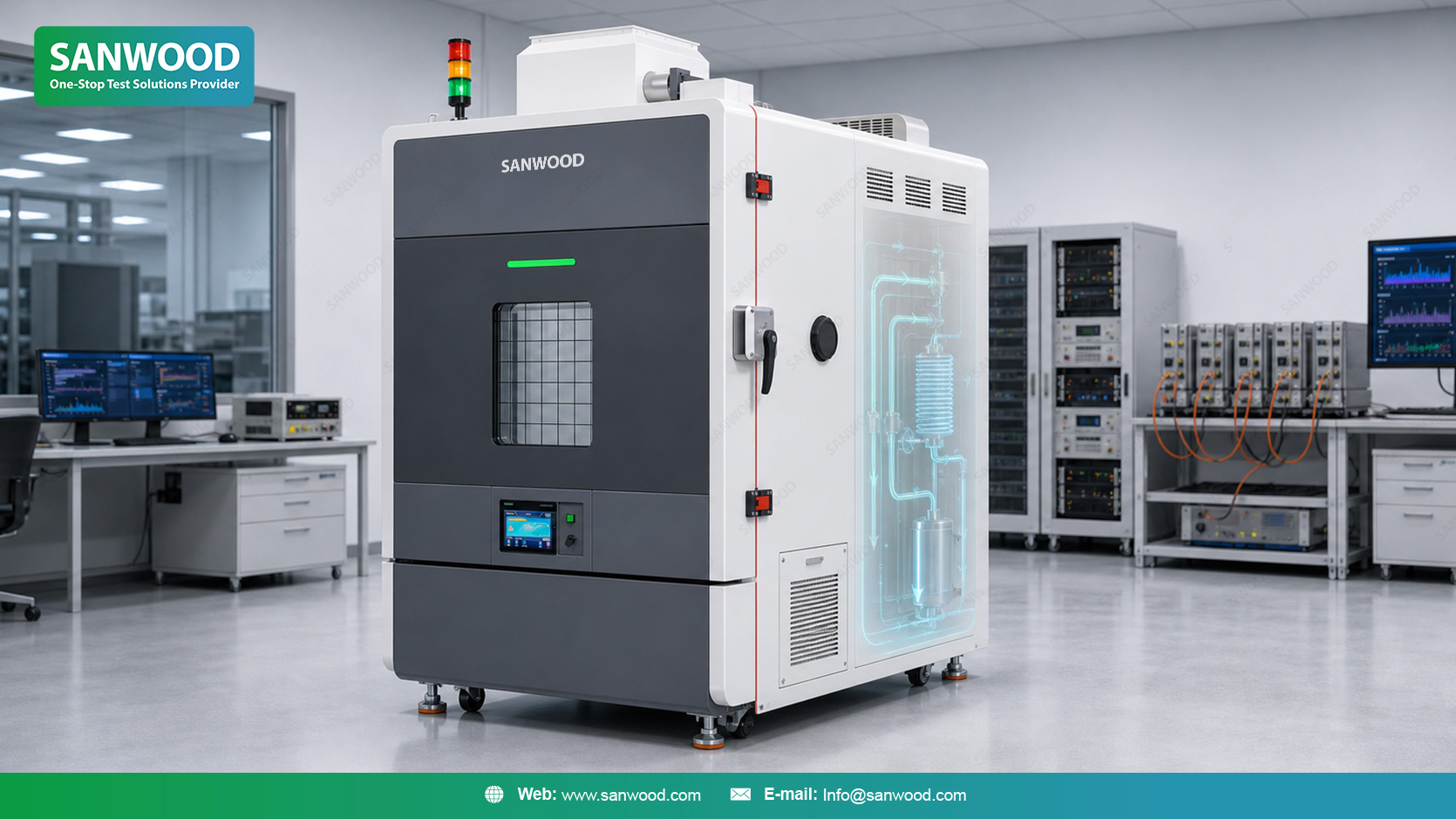
Battery testing laboratories often run long-duration tests: temperature cycling, high and low temperature storage, humidity exposure, aging and charge-discharge testing. These chambers may operate for many hours per day and remain in service for years.
At the same time, refrigerant policy is moving away from high-GWP fluorinated gases. The EU’s F-gas rules and the U.S. HFC phasedown both push the market toward lower climate impact refrigerant choices. For laboratories planning equipment investment today, this matters because a battery test chamber is not a short-life purchase.
In New Energy Batteries Testing, the question is no longer only:
• Can the chamber reach the target temperature?
• Is the workspace large enough?
• Can it support humidity or battery cycling?
There is now another question:
• Will the refrigeration system still make sense for future sustainability, service and compliance expectations?
This is where CO2 / R744 battery test chambers become part of the discussion.
R744 is the refrigerant designation for carbon dioxide. It is a natural refrigerant used in refrigeration and heat pump systems. In a battery test chamber, R744 can be used as part of a low-GWP cooling system designed for environmental simulation.
The basic value is straightforward: CO2 has a much lower climate impact profile than many traditional HFC refrigerants when compared by GWP.
For a laboratory buyer, however, the refrigerant name alone is not enough. Engineers should also confirm:
• Required temperature range
• Cooling capacity under real test load
• Ramp rate and recovery time
• Humidity range, if required
• Battery heat generation during cycling
• Ambient installation conditions
• Noise, heat rejection and ventilation
• Service access and technician capability
• Safety and pressure management of the refrigeration system
A CO2 refrigerant chamber is still a complete engineered system. The refrigerant supports the low-GWP strategy, but the chamber must still match the test profile.
The right comparison is not “CO2 is always better” or “traditional refrigerants are always wrong.” The better question is which system fits the laboratory’s test requirements and long-term operating strategy.
Selection Factor | Conventional Refrigerant Chamber | Climate Chambers with CO2 Refrigerant (R744) |
Refrigerant strategy | May use HFC or other synthetic refrigerants | Uses CO2 / R744 as a low-GWP refrigerant option |
Sustainability positioning | Depends on refrigerant type and local rules | Strong fit for low-GWP and long-term environmental planning |
Engineering focus | Mature service network and familiar design | Requires correct CO2 refrigeration design and service planning |
Battery testing relevance | Suitable when capacity and risk match the project | Suitable when low-GWP strategy and test performance both matter |
Selection risk | Future refrigerant availability and policy exposure | Must confirm temperature range, capacity, installation and service support |
For EV and ESS laboratories, the most useful approach is practical: compare the test profile, refrigeration performance, installation requirements and long-term service plan before deciding.
A low-GWP refrigerant does not solve a poorly specified chamber.
When a lithium-ion battery is charged or discharged inside the chamber, it becomes a heat source. A cell-level cycling test and a high-power battery pack test can place very different loads on the refrigeration system.
Before selecting a Battery Charge-Discharge Test Chamber or a CO2 refrigerant battery chamber, engineers should estimate:
• Battery size and weight
• Voltage, capacity and state of charge range
• Charge and discharge current
• Expected heat generation
• Test duration
• Temperature setpoint
• Required ramp rate
• Number of samples tested at one time
• Cable port and cycler connection requirements
Empty-chamber temperature performance does not tell the full story. A chamber may perform well without load but struggle to recover temperature when multiple cells, modules or packs are actively cycling.
For this reason, SANWOOD typically reviews the test object and heat load before recommending chamber size, refrigeration capacity and safety configuration.
CO2 refrigeration is especially relevant when the laboratory wants a lower-GWP direction for long-term environmental testing.
Typical applications may include:
• Lithium-ion cell temperature testing
• High and low temperature battery testing
• Temperature cycling for modules
• Temperature humidity reliability testing
• Charge-discharge testing under controlled temperature
• ESS and BESS component validation
• Long-duration aging and storage tests
• Low-carbon laboratory equipment planning
For cell or module testing, Climate Chambers with CO2 Refrigerant (R744) may support a lower-GWP chamber strategy. For active battery cycling, integration with Battery Charge-Discharge Test Chamber requirements should also be reviewed. For larger EV packs or ESS units, a Walk-In Battery Pack Test Chamber may require a project-specific refrigeration and installation discussion.
The key is to avoid treating “CO2 refrigerant” as a standalone feature. It should be connected to the real test object, heat load and laboratory workflow.
Different battery testing projects may require different chamber platforms.
Test Scenario | Product Direction | Engineering Note |
Low-GWP environmental testing for batteries | Climate Chambers with CO2 Refrigerant (R744) | Good starting point when sustainability and environmental simulation both matter |
Cell or module cycling under temperature | Battery Charge-Discharge Test Chamber | Confirm heat load, cable ports, cycler integration and safety logic |
High-risk lithium-ion safety testing | Explosion-Proof Battery Test Chamber | Refrigeration choice should be discussed together with safety configuration |
Space-efficient cell validation | Dual-Layer Battery Test Chamber | Useful when labs need more test capacity in limited floor space |
Higher-throughput battery testing | Triple-Layer Battery Test Chamber | Suitable for parallel cell or small module workflows |
EV pack or large ESS validation | Walk-In Battery Pack Test Chamber | Requires installation planning, heat load review and service access |
Liquid-cooled pack testing | Liquid-Cooled Battery Test Chamber | Cooling interface and chamber refrigeration must be evaluated together |
This table should guide internal linking and product navigation, not replace project engineering.
CO2 refrigeration systems operate differently from many conventional systems. That does not make them impractical; it means the chamber supplier should understand both refrigeration design and battery testing.
Before choosing a CO2 refrigerant chamber, engineers should ask:
• What temperature range is required?
• Is humidity control needed?
• What is the real battery heat load?
• What cooling capacity is available at the target conditions?
• What are the ambient temperature and installation conditions?
• Is water cooling or air cooling required?
• What maintenance access is needed?
• Does the supplier provide local or remote service support?
• How will the chamber integrate with battery cyclers, sensors and safety systems?
For battery labs, a good chamber discussion should include refrigeration performance and test safety in the same conversation. A low-GWP system still needs correct cable ports, monitoring, over-temperature protection and emergency logic when batteries are energized inside the chamber.
SANWOOD supports New Energy Batteries Testing projects with environmental and battery test chamber solutions for lithium-ion cells, modules, packs, EV batteries, ESS and BESS systems.
For laboratories considering low-GWP cooling, SANWOOD can help review whether Climate Chambers with CO2 Refrigerant (R744) are suitable for the required temperature range, humidity range, sample load, battery heat generation, installation environment and service plan.
Depending on the project, SANWOOD can support:
• Climate Chambers with CO2 Refrigerant (R744) for low-GWP environmental testing
• Battery Charge-Discharge Test Chamber for cycling under controlled temperature
• Explosion-Proof Battery Test Chamber for high-risk lithium-ion abuse and safety scenarios
• Dual-Layer Battery Test Chamber and Triple-Layer Battery Test Chamber for space-efficient battery testing
• Walk-In Battery Pack Test Chamber for large EV, ESS and BESS systems
• Liquid-Cooled Battery Test Chamber for battery packs with active liquid-cooling requirements
SANWOOD can also support chamber size evaluation, refrigeration capacity review, cable port design, battery cycler integration, safety configuration, installation planning, commissioning, operator training, preventive maintenance and after-sales service.
For international laboratories, this project-based approach is useful because low-GWP refrigeration, battery heat load and safety requirements must work together.
A CO2 refrigerant battery test chamber uses carbon dioxide, also known as R744, as the refrigerant in the cooling system. It supports environmental testing while helping laboratories move toward a low-GWP refrigeration strategy.
CO2 is the reference gas used for global warming potential, so it is commonly described as GWP=1. This makes R744 a low-GWP option compared with many traditional high-GWP refrigerants.
Yes, if the chamber is correctly selected for the required temperature range, cooling capacity, heat load, battery size, charge-discharge conditions and safety requirements.
It can be suitable for environmental and reliability testing projects, especially where long-term low-GWP planning matters. Large ESS and BESS systems may require custom chamber size, installation and heat load review.
No. Refrigerant selection and battery safety configuration are different decisions. Energized battery testing may still require cable ports, monitoring, over-temperature protection, emergency stop logic or an Explosion-Proof Battery Test Chamber, depending on the risk.
CO2 / R744 refrigerant battery test chambers help EV, ESS and lithium-ion battery laboratories align environmental testing with low-GWP refrigeration strategy.
The best chamber choice is not based on refrigerant alone. Engineers should review battery format, heat load, temperature range, humidity requirements, charge-discharge conditions, safety risk, installation environment and service support.
SANWOOD provides battery test chamber solutions for New Energy Batteries Testing, including Climate Chambers with CO2 Refrigerant (R744), Battery Charge-Discharge Test Chamber, Explosion-Proof Battery Test Chamber, Walk-In Battery Pack Test Chamber, Liquid-Cooled Battery Test Chamber, Dual-Layer Battery Test Chamber and Triple-Layer Battery Test Chamber.
Contact SANWOOD Technology to discuss a low-GWP battery test chamber solution for your EV, ESS, BESS or lithium-ion battery testing laboratory.
Sanwood is not just a company; it is a commitment to delivering high-quality products that stand the test of time.

 English
 中 文
中 文


 info@sanwood.com