2026-07-01 14:52:23
An Explosion-Proof Battery Test Chamber is used for lithium-ion cell, module and pack safety tests where venting, smoke, flame, rupture or pressure release may occur. In New Energy Batteries Testing, it gives engineers a controlled test space with safety functions such as reinforced structure, pressure relief, emergency exhaust, gas or smoke detection, door interlock and remote monitoring.
For cell-level abuse testing, the chamber should not be specified in the same way as a large pack or ESS system chamber. A single cylindrical cell, pouch cell or prismatic cell has a very different energy release, gas volume and fixture requirement compared with an EV battery pack. The chamber selection should start with the actual test object, test method and expected failure consequence.
The word "explosion-proof" also needs careful use. It does not mean one chamber can safely handle every possible battery explosion. A professional chamber discussion should review battery type, energy level, state of charge, abuse method, expected gas release, pressure path, exhaust design, fire risk and laboratory safety procedure.
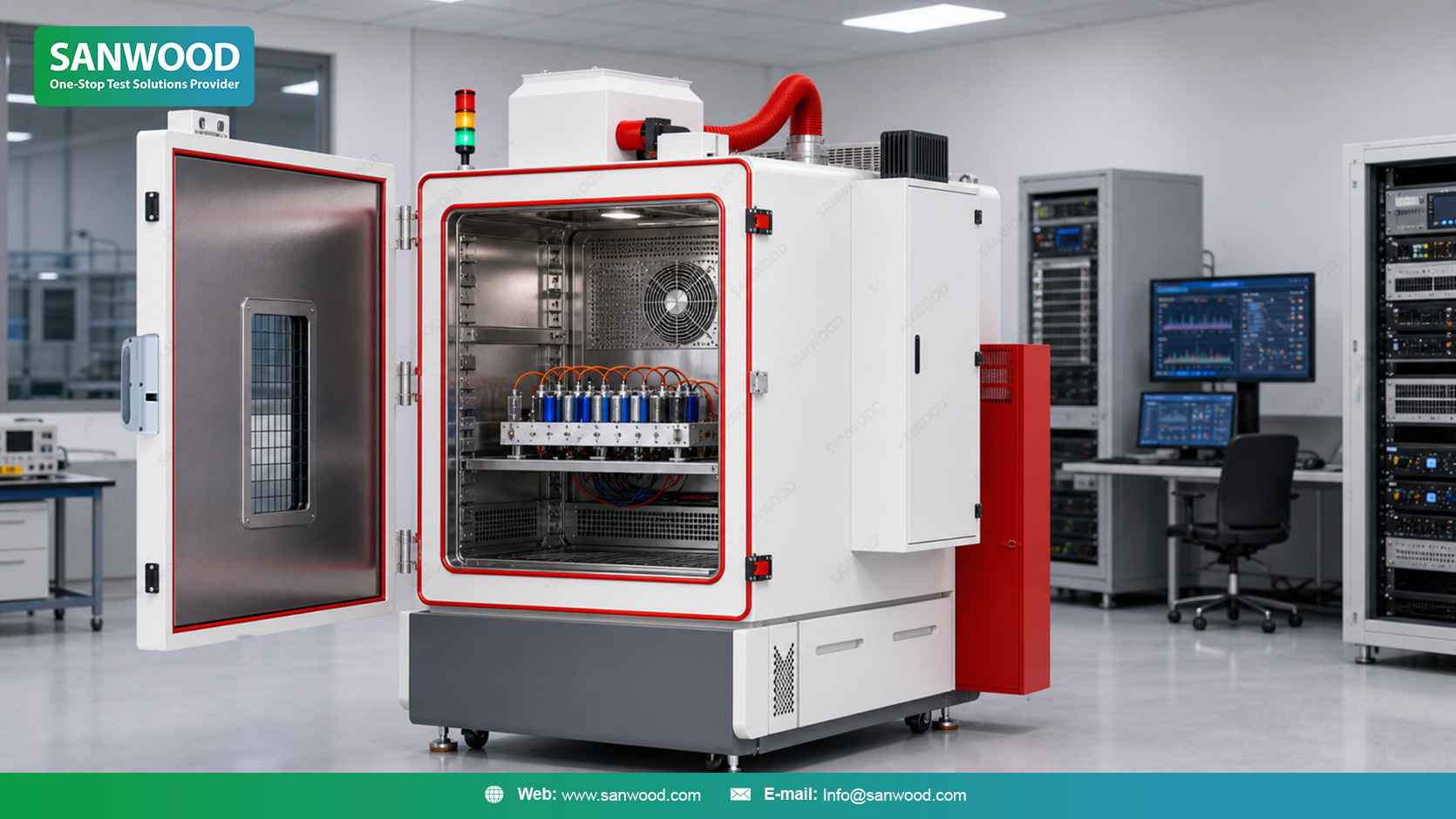
Battery laboratories are no longer testing only capacity and temperature performance. In EV, ESS and BESS development, engineers also need to understand what happens when a lithium-ion battery cell fails and whether the test space is prepared for that consequence.
In New Energy Batteries Testing, common questions include:
• Will the cell vent gas under overcharge or overheating?
• Does the cell produce smoke, flame or fragments?
• How should the chamber manage pressure release?
• Can the test fixture, cables and sensors survive the test condition?
A standard environmental test chamber may be suitable for low-risk temperature cycling or storage tests. Once the expected result may include venting, fire or rupture, the test space should be reviewed as a battery safety chamber project.
A standard environmental test chamber or climatic test chamber mainly controls temperature and humidity. It may help engineers evaluate cell performance, aging, storage behavior and environmental reliability.
An Explosion-Proof Battery Test Chamber adds safety design around the possible consequences of lithium-ion battery failure. The difference is not only the product name. It is the risk assumption behind the equipment.
Engineering Question | Standard Environmental / Climatic Chamber | Explosion-Proof Battery Test Chamber |
Main purpose | Temperature and humidity simulation | Battery abuse and safety testing with risk management |
Typical test object | Materials, components or low-risk battery samples | Lithium-ion cells, modules or packs under abuse conditions |
Failure assumption | No major gas, flame or pressure event | Possible venting, smoke, flame, rupture or pressure release |
Safety focus | Equipment protection and temperature control | Reinforced structure, pressure relief, exhaust, detection and interlock |
Operation mode | Often routine and local | Often monitored, interlocked and procedure-controlled |
Selection basis | Volume, temperature range and humidity range | Battery energy, failure mode, gas release, heat load and laboratory safety plan |
For lithium-ion cell abuse testing, the chamber does not need to be a large walk-in system. It may be a compact or medium-sized battery safety chamber with fixture access, cable ports, pressure relief and exhaust.
Cell testing is often the first stage of battery safety evaluation. Engineers may test cylindrical cells, pouch cells or small prismatic cells before moving to module or pack-level validation.
Typical cell-level abuse and safety tests may include:
• Overcharge testing
• Over-discharge testing
• External short-circuit support
• Thermal abuse or heating tests
• Venting observation
• Smoke and gas release monitoring
• Cell fixture and connector validation
• Early thermal runaway behavior evaluation
For these tests, the cell should be treated as a small but active risk source. The fixture must hold the cell securely, cable routing should be protected, and sensor placement should match the likely venting direction.
If the cell is charged or discharged inside the chamber, a Battery Charge-Discharge Test Chamber discussion may also be needed because heat generation, cycler connection and emergency stop logic affect the test.
An Explosion-Proof Battery Test Chamber may be considered when the test plan includes a defined risk of gas release, flame, rupture or pressure event.
It is especially relevant for:
• Lithium-ion cell abuse testing
• Cell venting and gas release observation
• Overcharge and over-discharge studies
• Thermal abuse testing
• Battery safety research
• EUCAR Hazard Level 0-7 related scenarios
• Early thermal runaway evaluation
• R&D comparison of cell chemistry or cell format
For lower-risk temperature and humidity tests, an environmental chamber may be enough. For active cycling under controlled temperature, a Battery Charge-Discharge Test Chamber may be more suitable. For large battery packs, engineers may need a Walk-In Battery Pack Test Chamber. The right product depends on what is being tested and what failure consequence the laboratory is preparing for.
SANWOOD battery chamber selection should be based on test object, risk level and laboratory workflow.
Test Scenario | Recommended Product Direction | Why It Matters |
Cell abuse and venting tests | Explosion-Proof Battery Test Chamber | Provides safety design for venting, smoke, pressure relief and monitored testing |
Cell cycling under temperature | Battery Charge-Discharge Test Chamber | Supports cycler connection, cable ports, heat load planning and safety logic |
Space-saving cell or small module testing | Dual-Layer Battery Test Chamber | Helps improve lab space efficiency for multiple parallel test conditions |
Higher-throughput cell testing | Triple-Layer Battery Test Chamber | Provides more independent or stacked test capacity for R&D and validation workflows |
EV pack or large ESS testing | Walk-In Battery Pack Test Chamber | Provides large internal volume, service access, floor loading and installation planning |
Liquid-cooled EV battery testing | Liquid-Cooled Battery Test Chamber | Supports liquid cooling interfaces, thermal management validation and pack-level testing |
Low-GWP environmental testing strategy | Climate Chambers with CO2 Refrigerant (R744) | Helps laboratories reduce reliance on high-GWP refrigerants and plan for long-term sustainability |
This table helps engineers choose the right starting point before discussing chamber size, temperature range, safety configuration and installation conditions.
The safety configuration of an Explosion-Proof Battery Test Chamber should come from the test risk.
Engineers should discuss:
• Reinforced chamber structure
• Pressure relief design
• Emergency exhaust system
• Gas detection
• Smoke detection
• Fire detection
• Fire protection interface
• Door safety interlock
• Over-temperature protection
• Emergency stop coordination
• Remote monitoring
• Alarm and shutdown logic
• Cable ports for sensors and battery cyclers
• Fixture access and post-test cleaning
For cell-level testing, some details are easy to overlook. A venting cylindrical cell, swelling pouch cell and prismatic cell may require different fixture and sensor arrangements.
No chamber should be described as preventing every thermal runaway or explosion. Its role is to help manage expected consequences according to a defined test scenario and laboratory safety procedure.
Before selecting a chamber, engineers should prepare more than temperature range.
Selection Factor | Information to Confirm |
Cell type | Cylindrical, pouch or prismatic cell |
Cell data | Size, weight, chemistry, voltage, capacity and energy |
State of charge | SOC range during the test |
Test method | Overcharge, heating, short circuit support, venting observation or other abuse condition |
Electrical operation | Charge-discharge current, cycler connection and emergency stop |
Expected result | No effect, leakage, venting, smoke, flame, rupture or pressure release |
Fixture design | Cell holder, insulation, thermal contact, sensor location and service access |
Chamber safety | Pressure relief, exhaust, detection, fire interface and interlock |
Installation | Exhaust duct, power, drainage, floor space and maintenance access |
This information helps SANWOOD evaluate whether the project should start from an Explosion-Proof Battery Test Chamber, a Battery Charge-Discharge Test Chamber, or another chamber configuration.
SANWOOD supports New Energy Batteries Testing projects with battery test chamber solutions for lithium-ion cells, modules, packs, EV batteries, ESS and BESS systems.
For lithium-ion cell abuse and safety testing, SANWOOD can review the test object, cell format, energy level, test method, expected hazard, fixture requirement and installation conditions before recommending the chamber configuration.
Depending on the project, SANWOOD can support:
• Explosion-Proof Battery Test Chamber for lithium-ion abuse, venting, smoke, fire and pressure-risk scenarios
• Battery Charge-Discharge Test Chamber for active cycling under controlled temperature conditions
• Dual-Layer Battery Test Chamber for space-efficient cell or small module testing
• Triple-Layer Battery Test Chamber for higher-throughput battery testing workflows
• Walk-In Battery Pack Test Chamber for EV pack, ESS and large battery system testing
• Liquid-Cooled Battery Test Chamber for battery packs with liquid cooling and thermal management requirements
• Climate Chambers with CO2 Refrigerant (R744) for laboratories that need low-GWP environmental testing options
SANWOOD can also support customized cable ports, fixture access, exhaust planning, gas or smoke detection, fire protection interface, remote monitoring, installation planning, commissioning, operator training, preventive maintenance and after-sales service.
An Explosion-Proof Battery Test Chamber is used for lithium-ion battery safety tests where venting, smoke, flame, rupture or pressure release may occur. It provides a controlled test space with project-specific safety functions.
Yes, if the chamber is configured around the actual cell type, energy level, test method, fixture design and expected hazard. Cell testing should use realistic fixtures and cell-to-chamber proportions, not pack-level assumptions.
Choose a Battery Charge-Discharge Test Chamber when the main requirement is active charging and discharging under controlled temperature conditions. If the same test includes abuse risk, additional safety configuration should be reviewed.
Usually yes. EV packs, ESS units and BESS systems often require a Walk-In Battery Pack Test Chamber because of size, weight, service access, heat load, cable routing and safety planning.
For suitable environmental testing projects, Climate Chambers with CO2 Refrigerant (R744) can be considered as part of a low-GWP refrigeration strategy. The final selection should also consider temperature range, cooling capacity, installation and service support.
No chamber should be described that way. The chamber helps detect, relieve, exhaust and manage expected consequences according to the project risk assessment. It does not guarantee prevention of thermal runaway, fire or explosion.
Explosion-proof battery testing is not only a product category. It is an engineering decision based on the battery format, energy level, abuse method, expected failure behavior and laboratory safety procedure.
For lithium-ion cell abuse testing, the chamber should be sized and configured around realistic CELL samples, safe fixtures, sensor access, pressure relief, exhaust and monitored operation. For modules, packs and ESS systems, the chamber discussion becomes larger and more installation-driven.
SANWOOD provides battery chamber solutions for New Energy Batteries Testing, including Explosion-Proof Battery Test Chamber, Battery Charge-Discharge Test Chamber, Dual-Layer Battery Test Chamber, Triple-Layer Battery Test Chamber, Walk-In Battery Pack Test Chamber, Liquid-Cooled Battery Test Chamber and Climate Chambers with CO2 Refrigerant (R744).
Contact SANWOOD Technology to discuss the right battery test chamber configuration for your lithium-ion safety testing project.
Sanwood is not just a company; it is a commitment to delivering high-quality products that stand the test of time.

 English
 中 文
中 文


 info@sanwood.com