2026-11-24 16:21:11
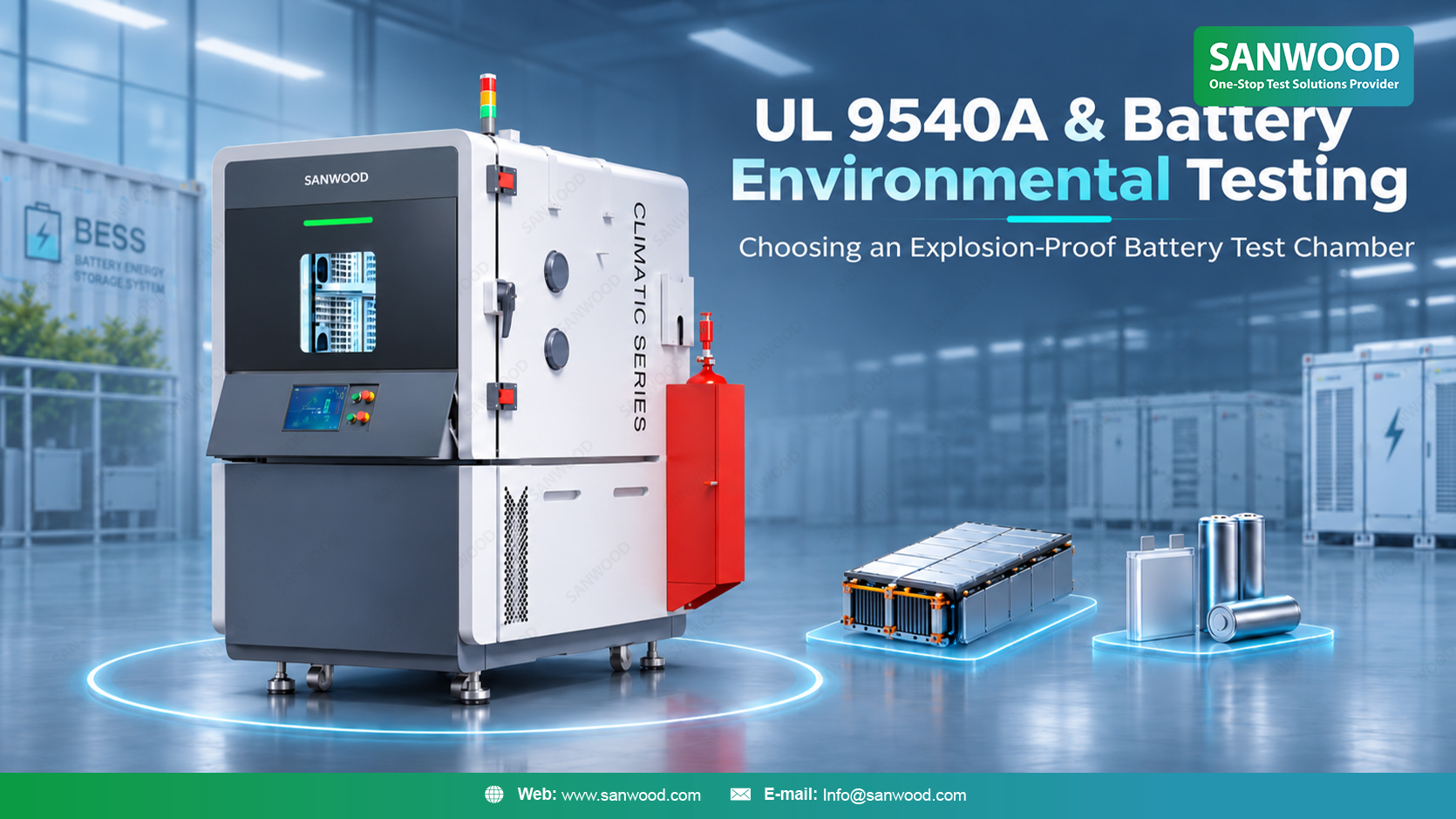
For lithium-ion battery and battery energy storage system (BESS) development, UL 9540A and battery environmental testing address different parts of product evaluation. Selecting an explosion-proof battery test chamber starts with deciding which work the equipment will perform: controlled environmental exposure, conditioning required by a test plan, or a separately assessed failure test. SANWOOD supplies environmental test chamber solutions for battery testing, including equipment intended for small pouch and cylindrical cells.
A useful purchase specification connects that equipment to an actual test. It identifies the battery, the environmental profile, any electrical operation and the protective configuration required for the proposed work.
UL 9540A is a test method for evaluating thermal runaway fire propagation in battery energy storage systems. Depending on the applicable edition and test level, the evaluation addresses cell behavior, released gases, propagation and fire-related effects in larger assemblies. The laboratory should establish the edition and test pathway for the project.
Battery environmental testing asks different questions. How does a cell perform after low-temperature exposure? What changes during repeated temperature cycling? Can the required conditions be maintained while cells generate heat during charging or discharging?
These activities can belong to the same development program, but their equipment and results serve different purposes:
| Work within the program | Question being investigated | Equipment scope to establish |
| Environmental exposure | How does the battery respond to specified temperature or humidity conditions? | Environmental control, loading arrangement and measurements |
| Conditioning assigned by a test plan | Has the specimen reached the condition required before the next test? | Specified conditions, stabilization criteria and transfer arrangements |
| BESS thermal runaway testing under UL 9540A | What thermal runaway and fire-propagation behavior occurs at the applicable test level? | Laboratory-defined test arrangement, instrumentation and facility provisions |
An Explosion-Proof Battery Test Chamber is not automatically a complete UL 9540A test system. Its role must be established within the laboratory's test plan before a configuration is selected.
For small-cell projects, the SANWOOD Explosion-Proof Battery Test Chamber is a relevant product starting point. Its published applications include pouch and cylindrical cells, while the control-system information lists programmable profiles, status monitoring and data logging. The quotation should identify the functions and recording channels included in the offered configuration.
Consider a pouch-cell development project with two tasks: storage at a specified temperature and charge-discharge evaluation during temperature exposure. The battery format is unchanged, but the second task introduces operating heat, power cables and an external cycler. A specification based only on cell dimensions and temperature limits would miss those differences.
Provide the proposed fixture layout and electrical operating schedule with the environmental profile. This lets the chamber discussion address cooling performance under the expected heat load, cable access and the space occupied by the complete arrangement.
Modules, packs and BESS cabinets require a separate equipment review. SANWOOD lists other battery chamber families for larger assemblies and different cooling arrangements; suitability for those samples should not be inferred from the small-cell product.
The temperature programmed into a controller, the measured chamber-air temperature and a cell-surface temperature are different quantities. A cell mounted between clamping plates may respond differently from an unrestrained cell, even when the air follows the same program.
For a useful specification, state which measurement determines stabilization and when the exposure dwell begins. If the procedure requires a particular specimen measurement to reach a defined condition, the chamber-air trace alone cannot demonstrate that requirement.
Active cycling adds another question: can the offered system maintain the required environment during the relevant electrical operating stages? An empty-chamber temperature range does not establish that loaded performance. Keep the cell quantity, fixture drawing and operating schedule with the proposed verification conditions so the equipment assessment reflects the intended use.
The term “explosion-proof” needs a documented scope. Battery chemistry, energy, state of charge, sample quantity and the intended test all affect the project assessment.
SANWOOD's product information identifies door restraints, pressure-relief provisions and gas detection. These features give buyers specific items to discuss: the restraint arrangement, the relief route, the monitored gases and the response associated with detection. The technical agreement should record the supplied configuration and its installation requirements.
Where charging or discharging is controlled externally, the response of the battery cycler also matters. Stopping an environmental program does not, by itself, establish that electrical operation has stopped. SANWOOD's battery chamber safety interlock guide discusses the interface questions to resolve before purchase.
Deliberate thermal runaway work requires its own laboratory and equipment assessment. Features listed for environmental testing should not be treated as evidence that every failure scenario is covered.
SANWOOD's documented battery temperature test chamber delivery project describes manufacture, factory inspection, site connection checks, commissioning and handover. It provides evidence of environmental equipment delivery experience, without establishing a UL 9540A test installation.
For a new project, carry the agreed application through to acceptance. Record the representative load, environmental profile, measurement locations, data records and interfaces to be demonstrated. If a substitute load is used, identify what it represents and what remains to be verified with the intended setup.
The resulting record is more useful than a completion statement alone: it shows the conditions under which the supplied equipment was checked.
No. Specify humidity control when the test procedure or moisture-related evaluation requires it. Provide the required temperature-humidity combinations, since a quoted humidity range alone does not describe every operating condition. A temperature-only task and combined temperature-humidity exposure may call for different SANWOOD configurations.
Calibration and application verification answer different questions. Review the certificate's measurement scope, conditions and uncertainty. Separately agree how performance will be demonstrated with the relevant load and test profile; the certificate alone does not establish performance with operating batteries.
Prepare the delivery route, floor layout, service clearances, electrical supply and proposed equipment location. Obtain the offered chamber's utility and heat-rejection requirements. Where exhaust or other facility connections are required, agree their routing and the responsibilities for providing them.
State the required channels, recording interval, file format, timestamps and retention needs. If chamber and cycler records will be compared, agree how sample identifiers and time references will be matched. Confirm which functions are included and whether additional software or instrumentation is required.
Send SANWOOD the cell format, chemistry, capacity or energy, state-of-charge range, sample count, fixture layout and environmental profile. Include any active cycling, expected heat generation and measurement requirements. If UL 9540A forms part of the wider program, provide the laboratory-defined role of the chamber alongside the applicable edition and test level.
Explore the SANWOOD Explosion-Proof Battery Test Chamber or contact info@sanwood.com to discuss equipment for your battery environmental testing project.
Sanwood is not just a company; it is a commitment to delivering high-quality products that stand the test of time.

 English
 中 文


 info@sanwood.com