2026-08-04 11:34:16
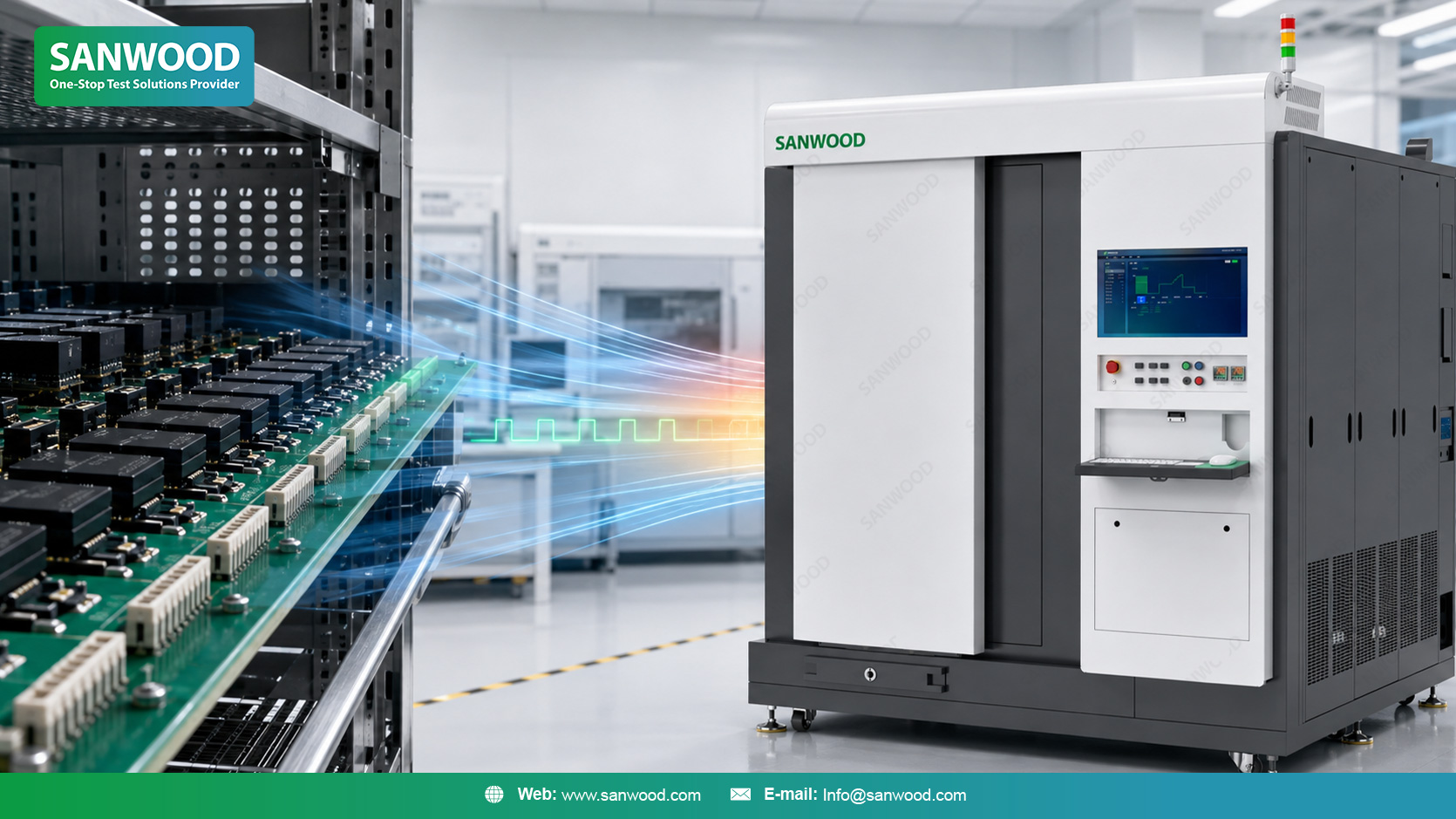
A BIB Temperature Test Chamber is a specialized environmental test chamber used with burn-in boards for powered IC burn-in, memory chip aging and early failure screening. It is different from a general climatic test chamber because the samples are active, electrically loaded and arranged on dense BIB boards. The chamber must control temperature while also supporting board racks, cable access, heat load, airflow uniformity, operator safety and data traceability. SANWOOD BIB temperature test chamber solutions are designed for semiconductor manufacturers, memory suppliers and reliability labs that need repeatable burn-in conditions before devices move into modules, systems or customer applications.
Modern semiconductor devices are tested many times before shipment. Wafer probing, final electrical testing and functional checks all remove obvious defects. But not every weak device fails at the first inspection.
Some failures need temperature, time and powered operation before they become visible.
An IC may pass a room-temperature check and still show abnormal leakage after several hours at high temperature. A memory chip may behave normally during a short read/write test but drift during longer powered aging. A controller IC may pass initial communication tests but lose stability after thermal and electrical stress. These are the kinds of risks that burn-in is meant to find.
IC burn-in is not only a harsh test. It is a controlled screening process. The goal is to expose early-life failures before weak devices are assembled into higher-value products such as automotive electronics, industrial controllers, storage modules, AI hardware, medical electronics or data center systems.
For this work, the chamber is not just a box that becomes hot or cold. It is part of the burn-in platform.
The BIB Temperature Test Chamber provides the environmental condition. Burn-in boards provide the device mounting and electrical connection. The power and signal system applies the operating stress. The monitoring system records which devices stay stable and which devices fail.
When these elements are designed together, burn-in can produce useful reliability data instead of only a pass/fail result.
BIB means burn-in board. In a semiconductor burn-in process, ICs are mounted on burn-in boards, and the boards are loaded into a temperature-controlled chamber. During the test, devices may be powered, biased, cycled, read, written, monitored or stressed according to the customer test method.
A BIB Temperature Test Chamber is built around this workflow.
It must maintain a controlled thermal environment while many active devices and boards are operating inside the workspace. This makes the design more demanding than a standard environmental test chamber used for passive samples.
A suitable BIB chamber usually needs to support:
Multi-layer burn-in board loading
Stable temperature control under powered heat load
Uniform airflow around densely arranged boards
Cable ports and electrical feedthroughs
Rear rack access or board maintenance access
Independent layer or zone management when required
ESD protection for semiconductor handling
Over-temperature, electrical and safety protection
Chamber data logging and communication output
Integration with PC systems, test platforms or MES
These details directly affect test confidence. If one board area receives less airflow, that device group may be stressed differently. If powered heat load is underestimated, the actual chamber condition may drift from the set point. If cable access is poorly planned, sealing, maintenance and repeatability can all suffer.
In burn-in testing, mechanical layout, electrical layout and chamber performance are inseparable.
Many product teams focus on average performance. Burn-in engineers look for the outliers.
The weak unit is the one that creates warranty cost, field service cost or customer failure analysis later. It may not represent the whole lot, but it can still damage product confidence.
Early failure screening is designed to find those weak units during the early part of the device life cycle. This is often connected to the concept of infant mortality in reliability engineering: devices with latent defects are more likely to fail early when exposed to controlled stress.
The failure source may vary:
Process variation
Weak metallization
Die attach or bonding defects
Package interface weakness
Contamination or ionic residue
Leakage path development
Marginal solder or interconnect behavior
Parameter drift under temperature
Abnormal current consumption
Communication instability during powered operation
The burn-in process cannot explain every root cause by itself. But it can help separate stable devices from devices that need further analysis.
That is why a BIB Temperature Test Chamber should be evaluated not only by temperature range, but also by how well it supports repeatable screening across boards, layers, lots and production batches.
A climatic test chamber is useful for many semiconductor, module and electronics reliability tests. It can provide controlled temperature and humidity conditions for storage exposure, operating checks, damp heat validation or broader environmental testing.
But IC burn-in has a different requirement.
In a general climatic test chamber, samples may sit on shelves or fixtures with limited electrical load. In a BIB chamber, the chamber is filled with boards, connectors, cables and powered devices. The internal structure changes airflow. The devices generate heat. Operators need repeatable access to boards. Test systems need communication and power routing. Failure data needs to be linked to device position, board channel, test time and chamber condition.
For this reason, a BIB Temperature Test Chamber is better understood as a powered semiconductor screening platform, not a general-purpose climatic chamber with boards placed inside.
Both chamber types are important, but they answer different questions.
A climatic test chamber may answer:
How does the product behave under controlled environmental exposure?
A BIB temperature test chamber asks:
Which powered ICs become unstable during controlled burn-in, and can the process find them consistently?
That distinction matters when selecting equipment for a reliability lab or production screening line.
An empty chamber test does not represent a loaded burn-in process.
Once burn-in boards, fixtures, sockets, devices and cables are installed, the thermal behavior changes. Powered devices release heat. Dense boards restrict airflow. Large fixtures add thermal mass. Long tests require stable control over time.
For IC burn-in, the useful question is not only whether the chamber can reach the target temperature. The more important question is whether it can hold a repeatable condition under the actual load.
This is especially important for memory IC burn-in, MCU aging, controller IC screening and semiconductor production lots where many units are tested together.
Burn-in boards create many small spaces where air must move evenly. If airflow is stronger near the inlet and weaker in the center or rear of the rack, devices may experience different stress.
A reliable BIB chamber design should consider board orientation, layer spacing, rack structure, air circulation, sensor placement and service access. Good airflow design helps reduce hot spots and improves confidence in lot-level screening data.
For high-density BIB loading, airflow is not a secondary detail. It is one of the conditions that defines the test.
Powered burn-in creates internal heat. The chamber must remove or balance that heat while maintaining the set condition. If the thermal load changes during operation, the chamber control system must respond without creating excessive overshoot or instability.
Heat-load planning should include the device power, board power, number of boards, operating pattern, fixture mass and expected test duration.
For some customers, this is where customized chamber design becomes necessary.
Burn-in requires power, signal and communication access. Cable ports and feedthroughs should support the test setup without compromising sealing, airflow or operator workflow.
Depending on the project, the chamber may need Ethernet, RS-485, PC connection, data interface, rear-side access, external control cabinet design or integration with customer-side test platforms.
The right configuration depends on how the burn-in board communicates with the test system.
Burn-in testing involves high-density boards, powered devices and repeated loading. Practical details matter:
ESD-safe operation
Independent power switches when required
Over-temperature protection
Emergency stop and alarm design
Clear board access for inspection
Maintainable rack and cable layout
Operator-friendly service space
These features help reduce daily operating risk. In production screening, reliability also depends on whether the equipment can be used safely and consistently by operators.
The value of burn-in increases when the result can be traced.
A useful system should help connect chamber condition, test time, lot, board, device position, channel and electrical result. This helps engineers identify whether a failure is device-related, board-related, fixture-related or condition-related.
For factories with digital quality systems, communication with PC software or MES may be part of the specification. For engineering labs, clear data export and alarm history may be enough.
Either way, burn-in data should not be isolated from reliability analysis.
SANWOOD BIB temperature test chambers can be configured for a range of semiconductor burn-in and powered aging applications, including:
Memory IC burn-in
MCU early failure screening
Controller IC powered aging
Sensor IC and mixed-signal device screening
Storage-related IC reliability testing
Automotive electronics component burn-in
Industrial semiconductor device aging
High-temperature dynamic aging
Engineering qualification support
Production lot screening
Failure analysis after abnormal electrical results
For memory and storage-related products, BIB burn-in can support screening before devices move into modules or systems. For automotive and industrial electronics, it can help reduce early field risk in applications where maintenance is expensive or difficult. For AI hardware and data infrastructure, it supports a more disciplined reliability process before components become part of higher-value assemblies.
Before selecting a BIB Temperature Test Chamber, prepare the information that will shape the configuration:
Device type: Memory IC, MCU, controller IC, sensor IC, storage IC or other semiconductor device
Burn-in purpose: engineering validation, qualification support, production screening or failure analysis
Burn-in board size, quantity, layer count and spacing
Socket type, fixture mass and board orientation
Power, current, voltage and signal requirements
Estimated heat load during powered operation
Temperature profile, dwell time and recovery requirement
Cable routing, communication interface and test-system connection
Chamber data logging and traceability requirements
Operator access, maintenance and ESD handling needs
Safety, alarm and protection requirements
PC, Ethernet, RS-485, MES or customer platform integration needs
This information helps determine chamber volume, airflow layout, rack design, port configuration, control system, safety design and customization scope.
SANWOOD Technology provides environmental test chamber and climatic test chamber solutions for semiconductor, memory, automotive electronics, industrial electronics, storage devices and advanced electronics reliability testing.
For BIB Temperature Test Chamber projects, SANWOOD focuses on the real burn-in workflow rather than only the temperature range. The review usually begins with the device, burn-in board, sample quantity, heat load, power access and data requirement.
SANWOOD can support customers with:
BIB chamber configuration review
Multi-layer burn-in board loading design
Powered heat-load evaluation
Airflow and temperature uniformity planning
Electrical access and cable port design
Operator safety and ESD protection planning
PC communication and data logging options
MES or customer test-platform integration discussion
High temperature dynamic aging system configuration
Long-term service, maintenance and calibration support
A good BIB chamber should make the burn-in process more repeatable, not more complicated. The equipment should fit the board, the electrical system, the operator workflow and the reliability goal.
A BIB Temperature Test Chamber is a semiconductor environmental test chamber used with burn-in boards for powered IC burn-in, memory chip aging and early failure screening. It controls the temperature condition while ICs operate under electrical stress.
BIB means burn-in board. It is the board or fixture used to mount and electrically connect multiple ICs during burn-in or powered aging.
A standard environmental test chamber usually controls conditions around passive or lightly powered samples. A BIB chamber must support dense burn-in boards, powered devices, electrical access, heat-load management, airflow uniformity, safety protection and traceable test data.
Common devices include Memory ICs, MCUs, controller ICs, sensor ICs, storage-related ICs, automotive semiconductor components and other devices that require powered burn-in or early failure screening.
Burn-in applies controlled temperature and electrical stress to expose weak devices that may pass initial inspection but fail early in operation. It helps reduce the risk of early field failure and supports lot quality control.
Important information includes device type, burn-in board size, board quantity, power requirement, heat load, temperature profile, cable access, monitoring method, data traceability needs, safety requirements and factory integration needs.
IC burn-in is most useful when it is treated as a controlled screening process, not a final formality. The purpose is to find weak devices early, understand lot behavior and protect downstream products from avoidable reliability risk.
A SANWOOD BIB Temperature Test Chamber supports that process by combining controlled environmental stress with burn-in board loading, powered operation, heat-load management, electrical access, safety protection and data traceability.
For semiconductor manufacturers, memory suppliers and reliability labs planning IC burn-in, memory chip aging or early failure screening, SANWOOD can help review the BIB chamber configuration around the actual device, board, heat load and test workflow.
Sanwood is not just a company; it is a commitment to delivering high-quality products that stand the test of time.

 English
 中 文
中 文


 info@sanwood.com