2026-09-29 16:13:07
For UN 38.3 battery testing, an environmental test chamber enquiry often covers two distinct jobs: T.1 requires a controlled low-pressure exposure, while T.2 requires a prescribed temperature sequence. A catalogue pressure limit, temperature range or product name does not establish what the offered chamber can do with the intended cells or batteries loaded. The purchasing question is which configuration can run each program and what equipment record it will provide.
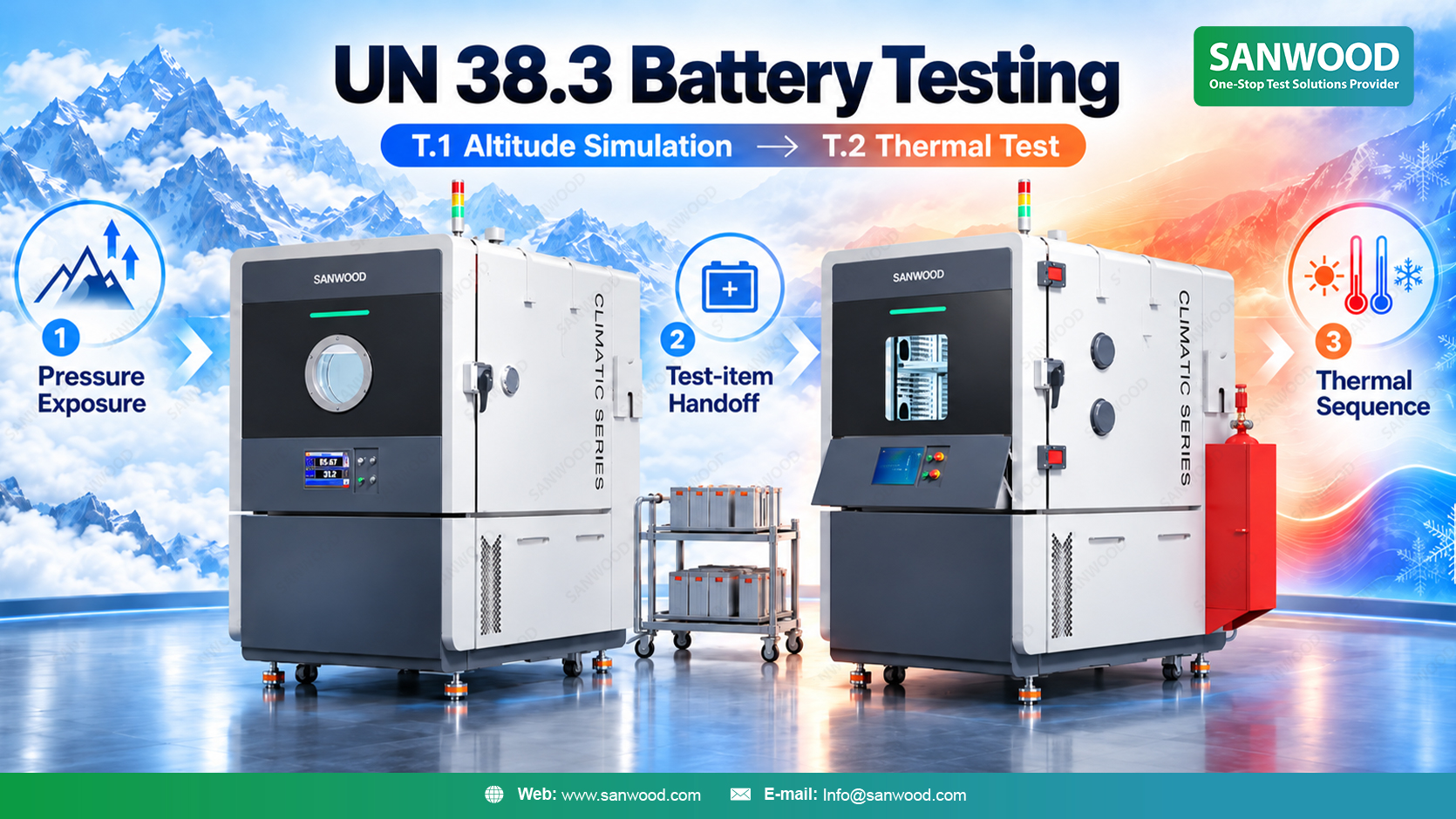
Subsection 38.3 of the UN Manual of Tests and Criteria defines the battery tests. The laboratory should identify the edition and amendment used in its test plan, the applicable cell or battery type and the sample set before requesting a chamber proposal. Where T.1–T.5 apply, those tests are conducted in sequence on the same cell or battery. Sample identity and handling between T.1 and T.2 therefore belong in the laboratory plan, even when the chambers are purchased separately.
A useful quotation assigns each stage to an equipment function under the stated load. The distinction is straightforward:
| Stage | Equipment proposal | Laboratory responsibility |
| T.1 Altitude simulation | Offered pressure function, options and loaded layout; pressure measurement channel and available run record. | Applicable procedure, test-item identity, observations and assessment. |
| T.2 Thermal test | Offered temperature function and loaded layout; complete sequence, movement between extremes and available run record. | Sample continuity, prescribed observations, deviations and assessment. |
SANWOOD's Altitude Test Chamber range is a starting point for T.1 low-pressure equipment selection. Temperature functions and other features depend on the configuration. A published pressure limit can help shortlist a model, but it is not evidence of the required exposure with the proposed number of test items, fixtures and interfaces in place.
The enquiry should pair the T.1 program with a loaded-layout sketch. In the response, identify the proposed model and options, the pressure measurement channel, the format of any run export and the equipment documents included. Larger items may lead to SANWOOD's Large Altitude Test Chambers; the pressure program and records still need to be assessed for that quoted unit. If a combined pressure and temperature chamber is proposed, its T.1 pressure function should be reviewed on its own merits. A stated temperature range does not settle the separate T.2 requirement.
For T.2, the useful comparison is the entire sequence in the laboratory’s applicable procedure: the temperature extremes, hold periods, repetitions and required way of moving between extremes. Those conditions should be considered with the actual test items and fixtures loaded. Hot and cold endpoints on a product page alone do not show how the quoted equipment will execute and document the sequence.
SANWOOD's Battery Test Chambers include several formats, so the offer should name the selected model and installed options rather than assume a feature from another chamber. The usable loaded layout, temperature measurement channel, available run data and any safety provisions should be stated for the specific test items. A thermal shock chamber may be one format to consider, but the category name by itself does not determine whether its transfer or temperature-change method matches T.2.
When separate chambers are used, a test-item ID should connect the T.1 pressure record to the T.2 temperature record. The laboratory documents the handoff, the item's condition between stages and any interruption or deviation under its procedure. Two exports bearing only chamber names leave that relationship unclear.
One chamber may be evaluated for both stages if its quoted configuration can perform each complete program with the intended load. That may reduce physical handling, but T.1 and T.2 remain distinct procedures. The proposal should still identify the pressure and temperature functions and the record available for each stage.
A chamber export reports the value recorded by an identified equipment channel during a run. It should be traceable to the chamber, program, time and test-item ID. Unless the item is separately instrumented, a chamber air-temperature trace is not a measurement of the battery’s internal temperature. Likewise, a chamber pressure trace does not establish the battery's test result.
The testing organization carries out the prescribed observations and measurements, evaluates deviations and prepares the complete test documentation. SANWOOD can identify which equipment documents and data exports are included in the offer; the laboratory decides how those records fit into its test file.
For a comparable UN 38.3 battery testing proposal, provide the applicable manual edition and amendment, T.1 pressure program, T.2 temperature program, cell or battery type and quantity, loaded-layout sketch, required equipment records and installation constraints. State whether the project calls for two chambers or asks SANWOOD to assess one configuration for both stages.
The response should name the offered model and options, assign each stage to an equipment function and describe the reviewed load and available records. Open capability or documentation points should remain explicit in the quotation. Contact SANWOOD with the test plan and layout to begin that configuration review.
It can be assessed as a project option. The exact offered configuration must be reviewed against each complete program under the intended load, with a distinct record identified for each stage. Catalogue pressure and temperature ranges alone do not define that combined scope.
The equipment format should follow the applicable T.2 sequence and its required method of changing or transferring between temperature extremes. The name “thermal shock chamber” does not establish a match without reviewing the proposed arrangement.
No. It documents the specified equipment measurement channel during the run. The testing organization performs the required battery checks and assesses the results under its test plan.
Sanwood is not just a company; it is a commitment to delivering high-quality products that stand the test of time.

 English
 中 文
中 文


 info@sanwood.com