2026-07-31 11:38:35
NAND, UFS, eMMC and SSD storage devices should not use one fixed environmental test profile. NAND testing often focuses on package, retention and moisture risk; UFS and eMMC add powered operation and host communication checks; enterprise SSD testing may require workload, telemetry and thermal management validation. SANWOOD environmental test chamber and climatic test chamber solutions help match temperature, humidity, cycling, HAST and powered aging methods to the actual storage device and reliability question.
Storage devices are often grouped under one simple word: memory. In real reliability work, that word is too broad.
Raw NAND, UFS, eMMC, removable storage, enterprise SSDs, and server storage modules do not face the same use conditions. They may share similar risks such as temperature drift, moisture exposure, package stress, data retention change, and controller behavior, but the test method should not be copied from one product to another without adjustment.
This is why storage device environmental testing needs a wider view. A storage product is not only judged by capacity, speed, endurance, or interface. It also needs evidence that it can remain stable under the environment where it will actually operate, ship, age, or be qualified.
For manufacturers, module suppliers, electronics brands, server hardware teams, and reliability labs, the practical question is not “Which chamber should we buy first?” It is “What reliability risk are we trying to understand?”
A useful environmental test chamber or climatic test chamber should help answer that question with repeatable conditions, proper sample loading, stable control, and enough access for powered testing or data monitoring when needed.
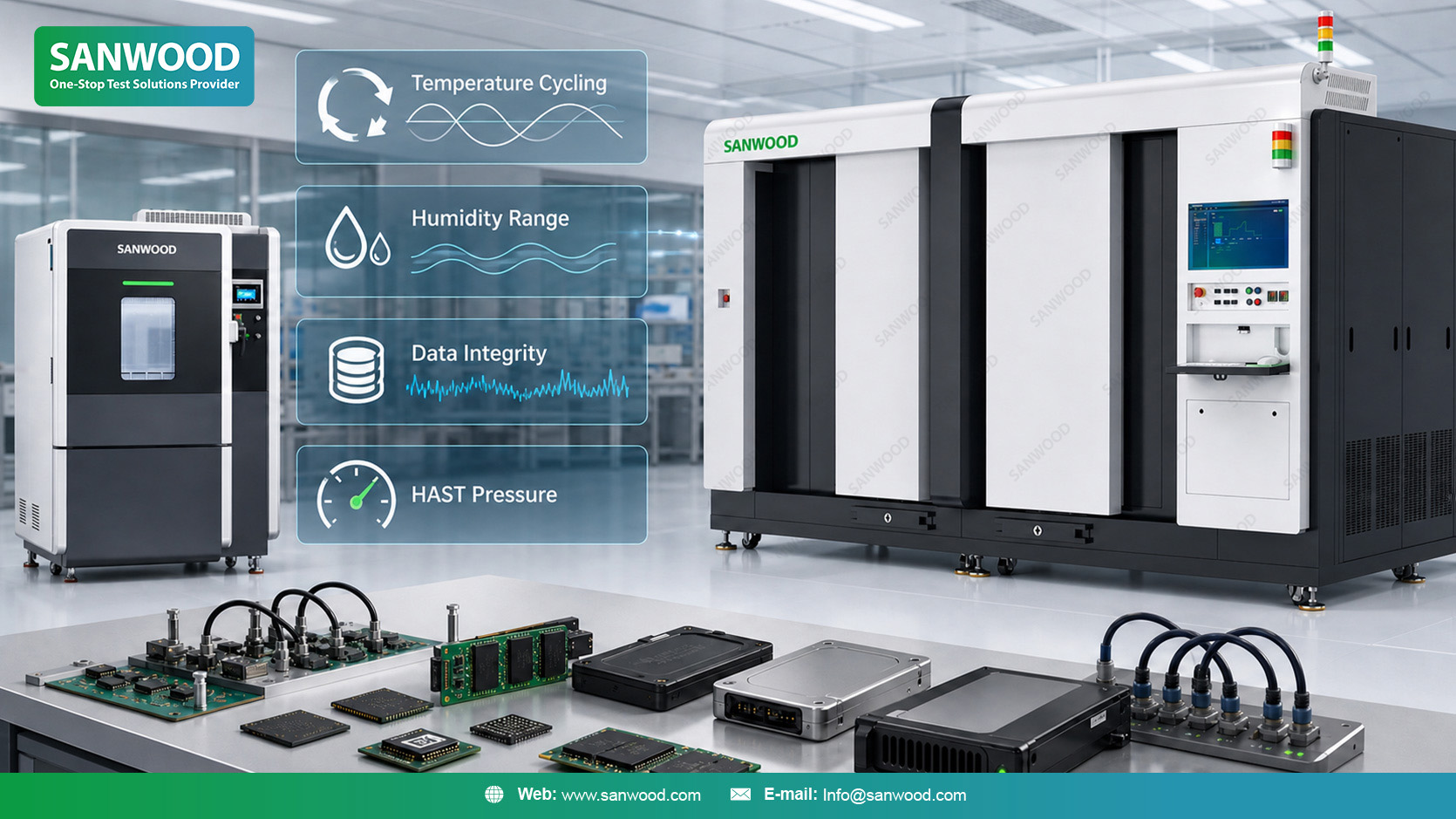
NAND flash may be evaluated as a memory component, package, or wafer-level device. UFS may be tested as a high-performance embedded storage solution for mobile, automotive, industrial, or edge devices. eMMC is still widely used in embedded systems where stable boot and data logging matter. Enterprise SSDs are tested as complete storage systems with controllers, firmware, NAND, power management, connectors, and high-speed interfaces.
These products overlap, but the reliability questions are different.
For NAND, the concern may begin with package reliability, moisture sensitivity, high-temperature storage, and data retention after stress. For UFS, the concern may include temperature behavior during faster embedded storage operation, package integrity, and host communication stability. For eMMC, the test may focus on cold start, high-temperature operation, powered read-write behavior, and board-level reliability. For SSDs, the test may expand into workload behavior, thermal management, drive telemetry, connector stress, and system-level validation.
One chamber type cannot answer every question by itself. A good test flow combines the right stress methods in the right order.
Device Type | Main Reliability Risk | Suggested Test Method | SANWOOD Product |
NAND | Retention change, package stress, moisture sensitivity | High-temperature storage, humidity exposure, HAST, temperature cycling | HAST Accelerated Aging Test Chamber, Temperature Humidity Test Chamber, High and Low Temperature Test Chamber |
UFS | High-speed embedded storage stability, host communication, package and board reliability | Powered temperature operation, damp heat, controlled temperature cycling | High and Low Temperature Test Chamber, Temperature Humidity Test Chamber, Rapid Temperature Change Test Chamber |
eMMC | Boot behavior, read-write stability, data logging, board-level reliability | Low/high temperature testing, powered read-write verification, post-stress data checks | eMMC High and Low Temperature Test Chamber, Temperature Test Chamber |
Enterprise SSD | Workload stability, telemetry, thermal throttling, connector and carrier stress | Powered workload temperature testing, high-temperature operation, cycling, data integrity verification | Enterprise SSD High and Low Temperature Test Chamber, High and Low Temperature Test Chamber |
Memory IC / Controller | Early-life defects, powered stability, batch screening | Burn-in, high-temperature dynamic aging, powered stress testing | BIB Temperature Test Chamber, High Temperature Dynamic Aging Test System |
Temperature is usually the first environmental condition storage teams check, and for good reason. It can influence electrical behavior, leakage, timing, retention, controller response, firmware stability, solder joints, connectors, and package materials.
A High and Low Temperature Test Chamber or Temperature Test Chamber is often used for:
Low-temperature storage or start-up checks
High-temperature operation
High-temperature storage
Powered read-write testing
Post-stress data verification
Product comparison across suppliers or lots
Board-level or module-level validation
For storage devices, the test setup matters as much as the temperature range. A loose component on a shelf, a mounted device on a PCB, and a drive installed in a tray or server fixture do not experience the same condition. Cable routing, airflow, heat load, fixture mass, and sensor placement can all change the actual stress applied to the sample.
This is why chamber selection should begin with the sample form and test profile, not only with the lowest and highest temperature on the specification sheet.
Humidity is often less visible than temperature, but it can create serious long-term risk.
Moisture can affect package materials, interfaces, corrosion paths, insulation behavior, solder joints, connectors, and PCB assemblies. In storage products, humidity risk may appear at the component level, module level, or system level depending on the package, board design, enclosure, and field environment.
A Temperature Humidity Test Chamber is useful when the product needs controlled damp heat exposure, storage validation, material comparison, or broader climatic test chamber evaluation. It is commonly considered for memory packages, UFS or eMMC modules, SSD components, PCB assemblies, connectors, and storage-related electronic modules.
For accelerated moisture-related evaluation, a HAST Accelerated Aging Test Chamber may be used when the test method calls for high temperature, high humidity, and pressure. HAST is more relevant for package moisture resistance, material interface behavior, corrosion risk, leakage paths, and biased or unbiased humidity stress, rather than general temperature operation.
The distinction is important. Temperature humidity testing and HAST are both moisture-related, but they do not answer the same reliability question.
Repeated temperature change can create stress that a simple hot or cold dwell does not reveal.
Storage devices include different materials: silicon, package materials, substrate, solder, connectors, PCB, metal shielding, adhesive, enclosure, and sometimes thermal pads or carriers. These materials expand and contract differently. Over many cycles, small mechanical changes can become meaningful.
A Rapid Temperature Change Test Chamber may be used when the goal is controlled temperature cycling with defined ramp rate, dwell time, and repeatable transitions. This can support evaluation of solder joint fatigue, connector behavior, board-level reliability, package stress, or module assembly stability.
A Thermal Shock Test Chamber serves a different purpose. It applies a more abrupt hot-cold transition and is usually selected when sudden temperature transfer is the concern. It should not be treated as a shortcut for every cycling test.
For NAND packages, UFS, eMMC modules, and SSD assemblies, the method should follow the expected failure mechanism. If the concern is accumulated fatigue, controlled cycling is usually more useful. If the concern is abrupt transition weakness, thermal shock may be appropriate.
Some storage risks appear only when the device is powered or active.
An unpowered storage sample can show package, material, or retention-related behavior. A powered sample can reveal more about boot, host communication, controller response, read-write stability, firmware behavior, error reporting, and workload sensitivity.
For eMMC and UFS, powered testing may involve boot checks, read-write verification, and host communication during temperature exposure. For enterprise SSDs, it may involve telemetry, workload logs, SMART data, error logs, power cycling, or data integrity checks. For memory ICs, a BIB Temperature Test Chamber or High Temperature Dynamic Aging Test System may be more suitable when batch powered operation or dynamic aging is required.
The point is not to power every sample in every test. The point is to define whether the expected risk is passive, active, or both.
A storage reliability program that never checks functional behavior under environmental stress may miss the issue that customers eventually see.
Storage device environmental testing may reference several standards or customer methods. The right reference depends on the product, application, and qualification stage.
Commonly referenced standards and methods may include:
JESD84 series for eMMC electrical standard references
JESD220 series for UFS electrical standard references
JESD218 for solid-state drive requirements and endurance test method
JESD219 for solid-state drive endurance workloads
JESD22-A103 for high temperature storage life
JESD22-A104 for temperature cycling
JESD22-A101 for steady-state temperature humidity bias life testing
JESD22-A110 for highly accelerated temperature and humidity stress testing
IEC 60068-2-1 for cold testing
IEC 60068-2-2 for dry heat testing
IEC 60068-2-14 for change of temperature
IEC 60068-2-78 for damp heat, steady state
ISO 16750-4 for climatic loads in road vehicle electronic equipment
OCP Datacenter NVMe SSD Specification for cloud and hyperscale SSD requirements
These references are not interchangeable. Some describe electrical behavior. Some describe environmental stress methods. Some are useful for automotive electronics or data center storage requirements. A chamber supports the environmental side of the test, while host systems, protocol tools, workload tools, fixtures, and data logging complete the validation setup.
A clearer way to plan storage testing is to start from the device type and ask what can fail.
For NAND packages, the test plan may focus on package moisture resistance, high-temperature storage, retention after stress, temperature cycling, and material interface behavior.
For UFS, the test plan may add powered operation, faster embedded storage communication, thermal behavior during system use, and board-level validation.
For eMMC, the plan may include low-temperature start-up, high-temperature operation, read-write checks, data logging stability, and post-stress verification for automotive, industrial, or edge devices.
For enterprise SSDs, the plan may include powered workload testing, drive telemetry, thermal management, connector and carrier stress, high-temperature operation, and multi-sample comparison for server or data center applications.
For memory ICs or controller devices, the plan may move toward burn-in, dynamic aging, or batch screening if early-life defects and powered stress are the main concern.
This approach avoids a common mistake: using the same chamber profile for every storage product simply because they all contain memory.
SANWOOD Technology provides environmental test chamber and climatic test chamber solutions for semiconductor, memory, storage, automotive electronics, industrial electronics, and data center hardware reliability testing.
For storage device programs, SANWOOD can help review chamber configuration across multiple product categories:
High and Low Temperature Test Chambers for component, PCB, module, and storage product temperature validation
Temperature Humidity Test Chambers for damp heat, storage exposure, and humidity-related reliability evaluation
eMMC High and Low Temperature Test Chambers for embedded storage read-write stability and board-level validation
Enterprise SSD High and Low Temperature Test Chambers for NVMe SSD, server storage, and AI data center workload testing
Rapid Temperature Change Test Chambers for controlled temperature cycling and repeated thermal stress
Thermal Shock Test Chambers for abrupt hot-cold transition testing
HAST Accelerated Aging Test Chambers for accelerated moisture-related package and component evaluation
BIB Temperature Test Chambers and High Temperature Dynamic Aging Test Systems for powered IC, Memory, MCU, and controller aging or screening
The best configuration depends on the test case, not the product name alone.
Before selecting a chamber, it is useful to define:
Device type: NAND, UFS, eMMC, SSD, Memory IC, controller, module, or PCB assembly
Test purpose: R&D validation, qualification, failure analysis, supplier comparison, or production screening
Required temperature, humidity, pressure, or transition profile
Powered or unpowered sample condition
Read-write, workload, boot, telemetry, or data verification needs
Sample quantity, fixture size, and heat load
Cable ports, feedthroughs, shelves, racks, trays, or BIB boards
Sensor placement and data recording requirements
Applicable JEDEC, IEC, ISO, OCP, automotive, or customer methods
These details help determine chamber volume, airflow layout, control performance, port configuration, safety design, anti-condensation needs, and possible customization.
Storage device environmental testing evaluates how NAND, UFS, eMMC, SSDs, memory ICs and related modules behave under temperature, humidity, pressure, cycling, shock or powered aging conditions. The purpose is to find reliability risks that may not appear during room-temperature functional checks.
The chamber depends on the risk being studied. A High and Low Temperature Test Chamber is common for hot and cold validation. A Temperature Humidity Test Chamber is used for damp heat and moisture exposure. A HAST Accelerated Aging Test Chamber supports accelerated humidity and pressure stress. A Rapid Temperature Change Test Chamber or Thermal Shock Test Chamber may be selected for repeated or abrupt temperature transitions.
They are built and used differently. NAND may need more focus on package, retention and moisture risks. UFS and eMMC often require powered operation and host communication checks. Enterprise SSDs may need workload, telemetry, thermal management and connector validation. A single generic memory test profile can miss product-specific failure modes.
Start with the device type, use environment, sample loading, powered-test requirement, expected failure mode and applicable standard or customer method. After those details are clear, the chamber type, fixture, cable access, monitoring points and stress profile can be selected with more confidence.
Storage device reliability testing should not be treated as one generic memory test.
NAND, UFS, eMMC, and enterprise SSDs each carry different design structures, workloads, installation methods, and field expectations. Temperature, humidity, cycling, shock, HAST, burn-in, and dynamic aging all have a place, but they should be selected according to the reliability question.
For storage manufacturers and electronics teams, good environmental testing creates evidence before the product reaches the field. It helps compare materials, suppliers, process changes, firmware versions, packages, and module designs with more discipline.
If your team is planning environmental testing for NAND, UFS, eMMC, enterprise SSDs, Memory ICs, or storage-related electronic modules, share the device type, sample quantity, test standard, temperature and humidity profile, powered-test requirement, fixture design, and monitoring needs. SANWOOD can help review the chamber configuration and recommend a practical storage device reliability test setup.
Sanwood is not just a company; it is a commitment to delivering high-quality products that stand the test of time.

 English
 中 文
中 文


 info@sanwood.com