2026-07-20 16:28:22
HBM, chiplet architecture, and advanced packaging are changing the way reliability engineers think about thermal stress.
The reason is practical. More performance is now packed into smaller and denser structures. Logic dies, memory stacks, substrates, interposers, underfill materials, solder joints, micro-bumps, and board-level connections all need to work together through repeated temperature changes.
For AI processors, HBM-related devices, chiplet assemblies, and advanced IC packages, room-temperature functional testing is not enough. Engineers also need to understand how the package behaves after repeated expansion and contraction.
That is where thermal cycling testing becomes important.
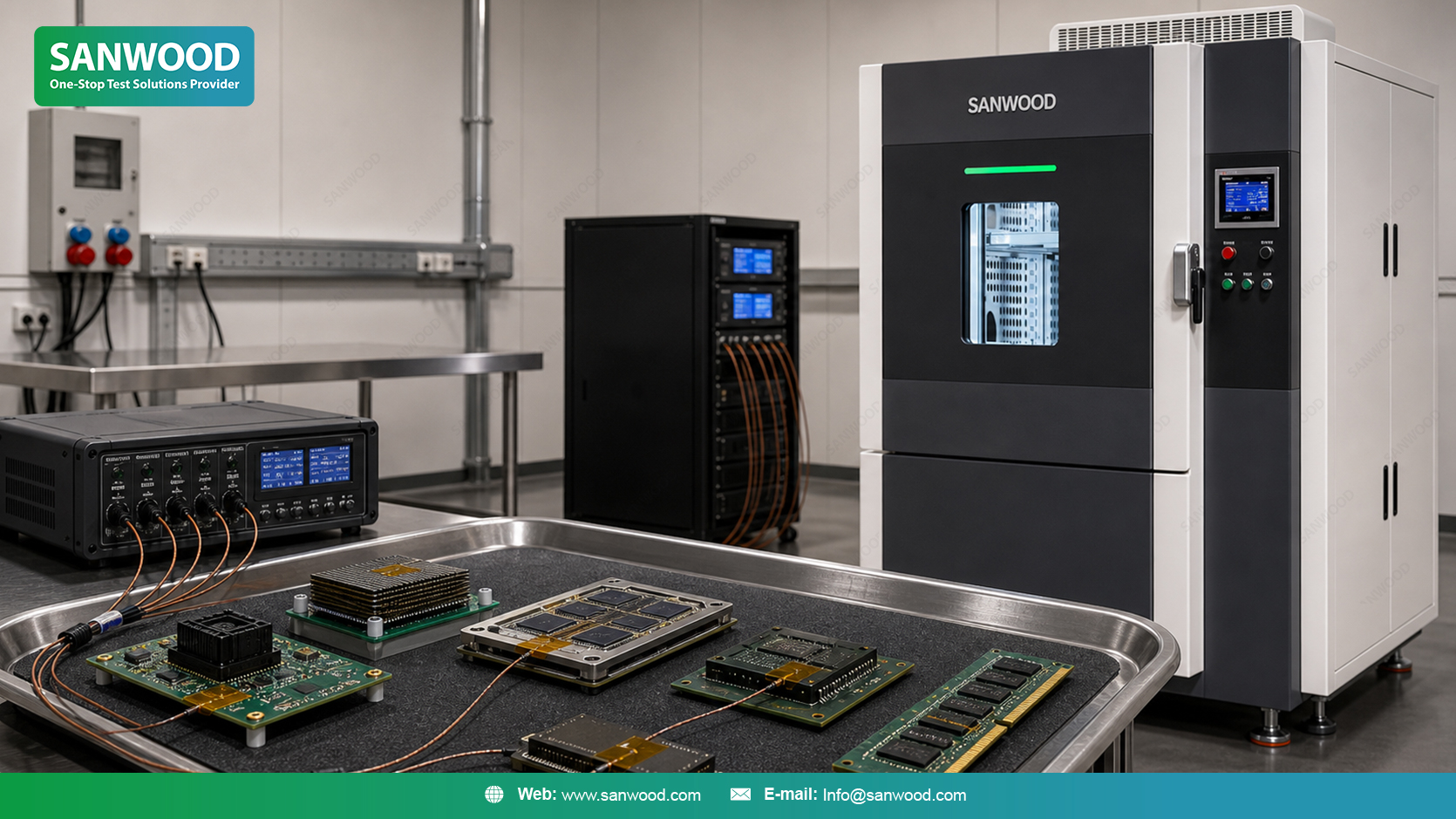
In advanced semiconductor packaging, heat alone is not the only concern. The bigger reliability question is what happens when the package moves between low and high temperatures again and again.
Different materials expand and contract at different rates. Silicon, substrate materials, solder, copper, underfill, adhesives, and molding compounds do not respond to temperature change in exactly the same way. This difference is commonly described as CTE mismatch.
Over one cycle, the effect may be small. Over hundreds or thousands of cycles, the accumulated stress can become meaningful.
For HBM, chiplet packaging, AI processors, and advanced packaging samples, repeated thermal stress may contribute to:
- Solder joint fatigue
- Micro-bump fatigue
- Package warpage
- Interface delamination
- Die or substrate cracking
- Interconnect degradation
- Board-level connection issues
Thermal cycling testing helps reliability teams observe these risks before they appear as field failures, yield loss, or customer qualification problems.
HBM and chiplet designs are different from many traditional packages because they rely on dense interconnects and complex material stacks. This makes the test setup more sensitive.
If temperature stability is poor, the test result may not reflect actual package behavior. If airflow is blocked by a fixture, one sample may see a different condition from another. If the ramp rate is not controlled, the actual stress profile may be different from the planned profile.
For semiconductor reliability testing, the chamber must do more than reach the target temperature. It must reproduce the planned stress condition consistently.
Reliability engineers should pay attention to:
- Temperature range
- Temperature stability
- Temperature uniformity
- Ramp rate
- Dwell time accuracy
- Recovery performance
- Airflow design
- Sample loading capacity
- Cable and fixture arrangement
- Sensor placement and data recording
These details are especially important when engineers compare package designs, materials, process changes, or supplier lots.
A useful thermal cycling test should answer a clear engineering question: can the package tolerate repeated temperature change under controlled conditions?
A typical profile may include low-temperature dwell, a controlled ramp, high-temperature dwell, and repeated cycling. Each stage needs to be stable enough for the data to be meaningful.
For example, if several HBM-related samples are placed in different areas of the chamber, the engineer needs confidence that each sample experienced the intended condition. If the workspace is not uniform, differences in failure behavior may come from the chamber environment rather than the package design.
This is why repeatability matters as much as temperature range.
Thermal cycling and thermal shock are often mentioned together, but they should not be treated as the same test.
Thermal cycling uses controlled transitions between low and high temperature conditions. It is useful for studying repeated thermo-mechanical stress, solder fatigue, package behavior, and long-term reliability trends.
Thermal shock applies a faster and more abrupt temperature change. It is useful when the test purpose is to expose weaknesses under sudden hot-cold transfer conditions.
For HBM, chiplet, and advanced packaging applications, the right method depends on the failure mode. If the goal is to evaluate accumulated stress from repeated temperature change, thermal cycling is usually the better starting point.
One common mistake is to focus only on empty-chamber performance.
In real semiconductor reliability labs, the chamber may contain sample carriers, test boards, socket fixtures, thermocouple wires, powered samples, or monitoring cables. These items affect airflow, heat transfer, recovery time, and workspace uniformity.
For advanced packaging tests, this matters even more. Dense fixtures can block airflow. Heavy sample carriers can slow temperature response. Powered samples can create additional heat load. Poor sensor placement can hide the real temperature near the package.
Before choosing a chamber, reliability engineers should define:
- Sample size and quantity
- Fixture dimensions
- Test board layout
- Whether samples are powered
- Cable routing
- Required sensor points
- Ramp rate and dwell time
- Cycle count
- Uniformity expectations
A thermal cycling test is only as useful as the condition actually experienced by the sample.
SANWOOD Technology supports semiconductor, memory, and electronics reliability testing with environmental test chambers designed for controlled temperature stress.
For HBM, chiplet, AI processor, and advanced packaging applications, the Rapid Temperature Change Test Chamber is often the key product because it supports repeated temperature transitions with controlled ramp rate, stability, uniformity, and dwell periods.
In some projects, a High and Low Temperature Test Chamber may be enough for basic temperature exposure or storage testing. But when the test requires repeated temperature cycling, defined ramp rates, and stable dwell conditions, a Rapid Temperature Change Test Chamber is usually the more practical choice.
The selection should start from the test profile, not only from the product model.
For thermal cycling tests, reliability engineers should clarify:
- What package or assembly will be tested?
- What temperature range is required?
- What ramp rate is needed?
- What dwell time is planned?
- How many cycles will be run?
- How many samples will be loaded?
- Will the samples be powered or monitored?
- What fixtures or test boards will be used?
- Where should sensors be placed?
- How will the data be recorded?
- Is a standard chamber enough, or is customization required?
These answers help determine chamber capacity, airflow design, cable ports, fixture layout, and monitoring needs.
HBM, chiplet, and advanced packaging technologies are raising the value and complexity of semiconductor devices. As packages become denser, thermal cycling testing becomes more than a qualification step. It becomes a way to understand how the package responds to real stress over time.
For reliability engineers, the chamber must do more than reach high and low temperatures. It must reproduce the same stress condition consistently.
If your team is planning thermal cycling tests for HBM-related devices, chiplet assemblies, AI processors, or advanced packaging samples, SANWOOD can help review your test profile and recommend a suitable chamber configuration.
Sanwood is not just a company; it is a commitment to delivering high-quality products that stand the test of time.

 English
 中 文
中 文


 info@sanwood.com