2026-08-27 15:12:08
Battery test chamber sizing should not begin with a rough estimate of the space occupied by the battery. Whether the project uses a reach-in or walk-in battery environmental test chamber, the complete loaded configuration must be assessed, including the test object, fixtures, cables, sensors, sample arrangement and handling equipment.
Operating heat load, access requirements and installation conditions also affect the selection. Nominal chamber volume is therefore a starting reference, not a complete sizing method.
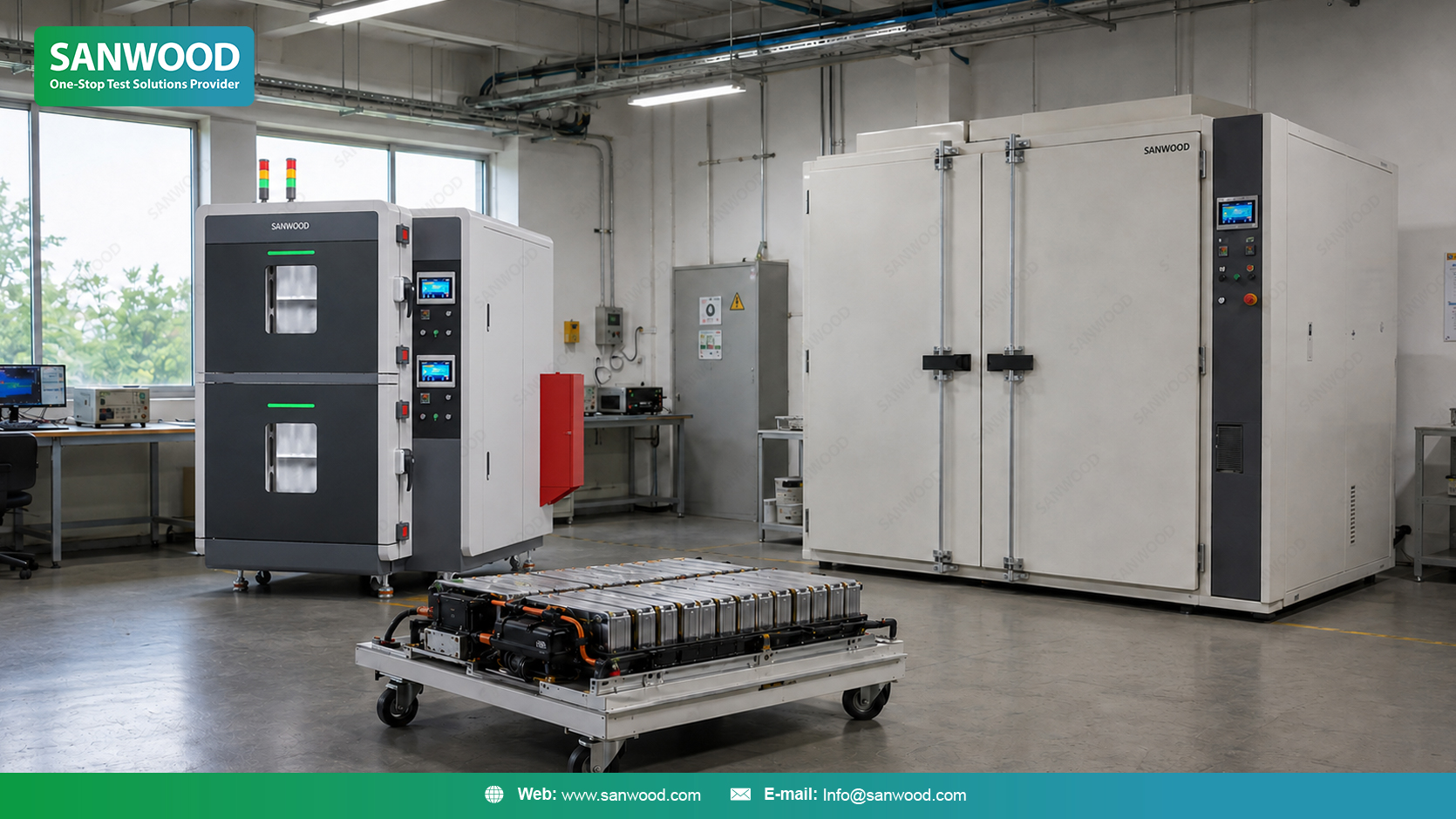
The dimensions of a cell, module, pack or ESS cabinet do not represent the full space required during testing. The sizing drawing should include every item that remains inside the workspace:
The battery in its actual test orientation
Shelves, trays, racks or restraint fixtures
Connectors, cable bends and sensor wiring
Multiple samples and their intended arrangement
A cart, pallet or trolley if it remains inside
Space required for connection, inspection and removal
Orientation matters. A long module installed horizontally occupies the chamber differently from the same module placed vertically. A rack containing many cells also creates different space and routing requirements from a single enclosed pack.
A dimensioned layout drawing is therefore more useful than the battery dimensions or nominal test-item volume alone. It allows the internal workspace, door opening and loading method to be reviewed as one system.
Nominal volume describes the empty internal space. Usable workspace is the area that remains practical after the complete test setup has been installed.
Sizing factor | What should be checked |
Loaded envelope | Maximum width, height and depth of the test item and fixtures |
Sample arrangement | Quantity, orientation and layout of all samples |
Cable access | Routing space for power, signal and sensor cables |
Measurement access | Locations required for sensors and inspection |
Handling access | Space needed to install, connect and remove the load |
Load support | Total weight and how it is distributed on shelves or the floor |
There is no universal clearance ratio for every battery test. The required workspace depends on the test-item geometry, fixture design, sample density and chamber layout. A fixed test-item-to-chamber ratio can be used only for early comparison; it should not replace a project-specific assessment.
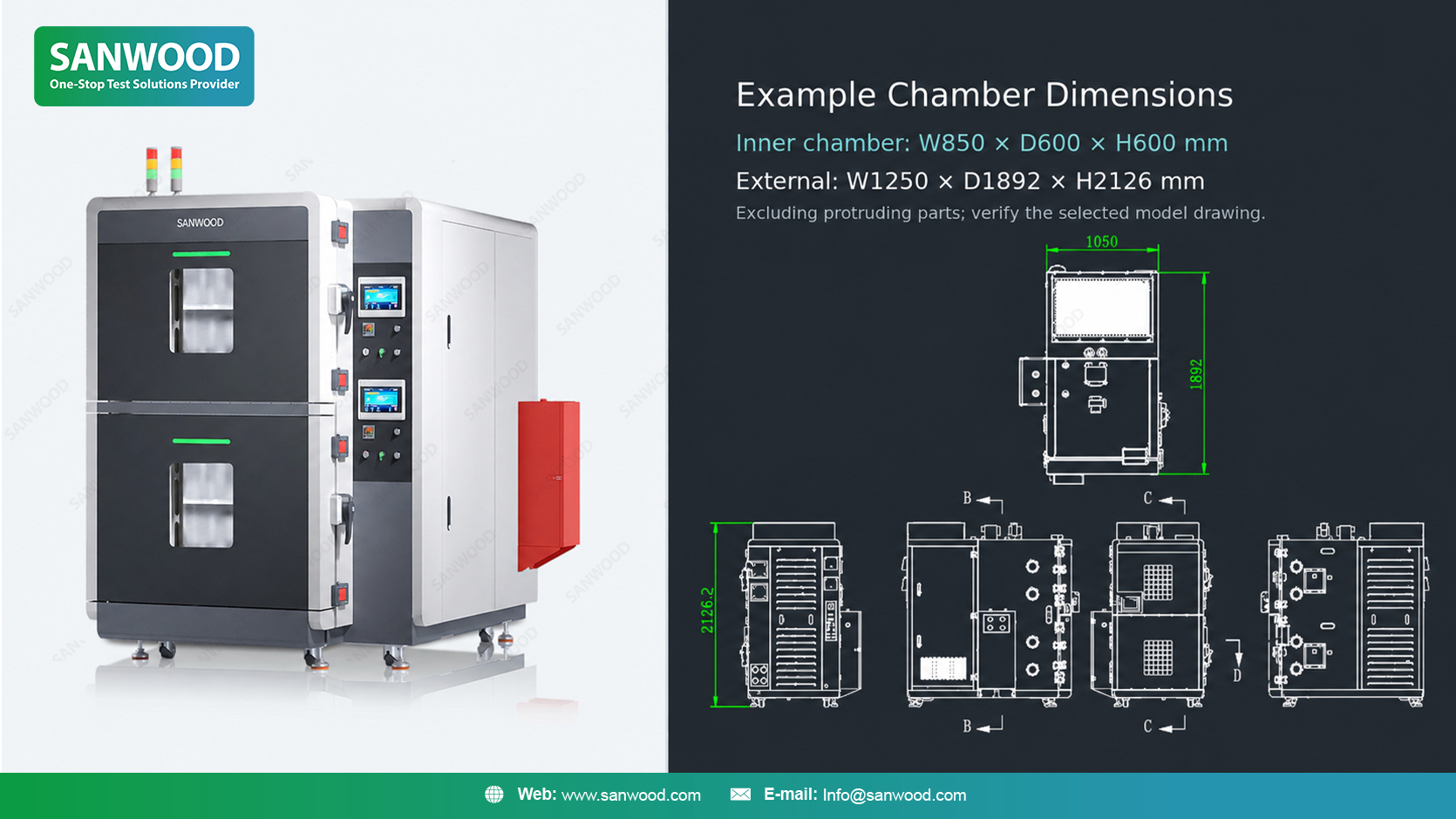
A battery being charged or discharged may generate heat inside the chamber. The amount and timing depend on the battery, number of active samples and operating profile. EV battery test chamber sizing must therefore consider the intended test conditions, not only whether the pack fits inside the workspace.
Useful project inputs include:
Battery type and number of active samples
Mass and construction of the battery or other test item
Charge-discharge sequence
Expected heat dissipation, if known
Requested temperature and humidity profile
Transition, dwell and test duration
Other equipment located inside the workspace
Battery energy, voltage or current alone cannot determine the required chamber size. If heat-dissipation data are not yet available, they should be marked as pending for engineering review instead of replaced with an assumed formula.
Projects involving active cycling can also review SANWOOD's battery charge-discharge test chamber page for relevant product context. The selected configuration must still be evaluated against the actual load and test profile.
Battery test chamber size and format selection should follow the loaded layout and test workflow. For an environmental chamber used for battery testing, the battery category alone does not determine the required chamber format or usable workspace.
Test object | Main sizing concerns | Format that may be evaluated |
Individual cells | Sample quantity, trays, spacing and cable routing | Reach-in chamber or separate test compartments |
Battery modules | Fixture size, terminal access, weight and operating heat | Reach-in or multi-layer chamber configuration |
EV battery packs | Pack dimensions, cart or pallet, door access and cable routing | Large reach-in or walk-in layout |
ESS/BESS cabinets | Cabinet dimensions, service access, moving route and floor load | Walk-in or project-specific layout |
A reach-in chamber may be suitable when the complete load can pass through the door and be connected within the available workspace. A multi-layer chamber configuration may be considered when separate sample groups or parallel tests are required. The required independence of each workspace should be stated in the project specification.
A walk-in battery pack test chamber may be evaluated for large or heavy packs, cabinets, carts or pallet-loaded assemblies. “Walk-in” describes the chamber format; it does not confirm that the workspace, thermal capacity or site conditions are suitable for a specific test.
Battery test chamber size selection continues outside the chamber. The chamber and loaded test item must reach the test area, fit the allocated location and connect to the required site utilities.
Before confirming the chamber size, check:
Laboratory entrance, doorways, lifts and turning space
Chamber footprint and maintenance access
Test-item loading route and handling equipment
Floor condition and loaded weight distribution
Power, cooling, drainage or other required utilities
Cable routes to external power and measurement equipment
Ambient conditions at the installation site
Battery risk requirements should be reviewed separately from physical sizing. Battery chemistry, energy, state of charge, test method, operating condition and expected abnormal behavior may affect the required chamber configuration. No safety function or protection level should be assumed from chamber volume or product naming alone.
The following information gives engineering a practical basis for evaluating the project:
1. Test object: cell, module, EV pack, ESS cabinet or another assembly
2. Dimensioned drawing of the complete loaded configuration, including the largest realistic future test-item configuration
3. Individual and total loaded weight, including its distribution on shelves or the chamber floor
4. Sample quantity, orientation, required test groups and realistic future throughput
5. Environmental profile, transitions, dwell times and duration
6. Operating condition and expected heat dissipation, if known
7. Fixtures, sensors, connectors and cable-routing requirements
8. Loading method, door access, delivery route and handling equipment
9. Test-risk information and laboratory safety requirements
10. Installation footprint, available utilities, destination market and required project documentation
If a value is not yet known, mark it as pending. This is more useful than inserting a generic estimate that may lead the selection in the wrong direction.
For additional application information, see SANWOOD's battery test chambers and EV and energy storage battery testing solutions.
Battery test chamber sizing should connect the loaded dimensions, sample arrangement, operating heat load, handling method, chamber format and installation site. The same principle applies when selecting an environmental chamber for EV battery packs or BESS cabinets: nominal volume is useful, but it cannot answer these questions on its own.
If you have specific requirements, send the information above to SANWOOD Technology. We will assess the battery test chamber specification according to the project requirements. Any recommendation will be based on the complete test configuration.
Begin with a dimensioned drawing of the complete loaded setup, including the battery or other test item, fixtures, cables, sensors and handling equipment. Then define sample quantity, weight, operating heat load, environmental profile, access and installation conditions. These inputs establish the usable workspace and the chamber format that should be evaluated. Do not select the chamber using the battery dimensions or a fixed volume ratio alone.
No. Battery energy does not describe the enclosure dimensions, fixture layout, cable routing, loaded weight or operating heat load. Batteries with similar energy ratings can require different workspaces and test conditions. The complete physical and operating configuration must be reviewed.
A walk-in format may be considered when a pack, ESS cabinet, cart or pallet requires more loading and service space than a reach-in chamber can provide. Door dimensions, loading route, floor load, utilities and maintenance access should be assessed together before the format is selected.
Sanwood is not just a company; it is a commitment to delivering high-quality products that stand the test of time.

 English
 中 文
中 文


 info@sanwood.com