2026-06-29 15:45:41
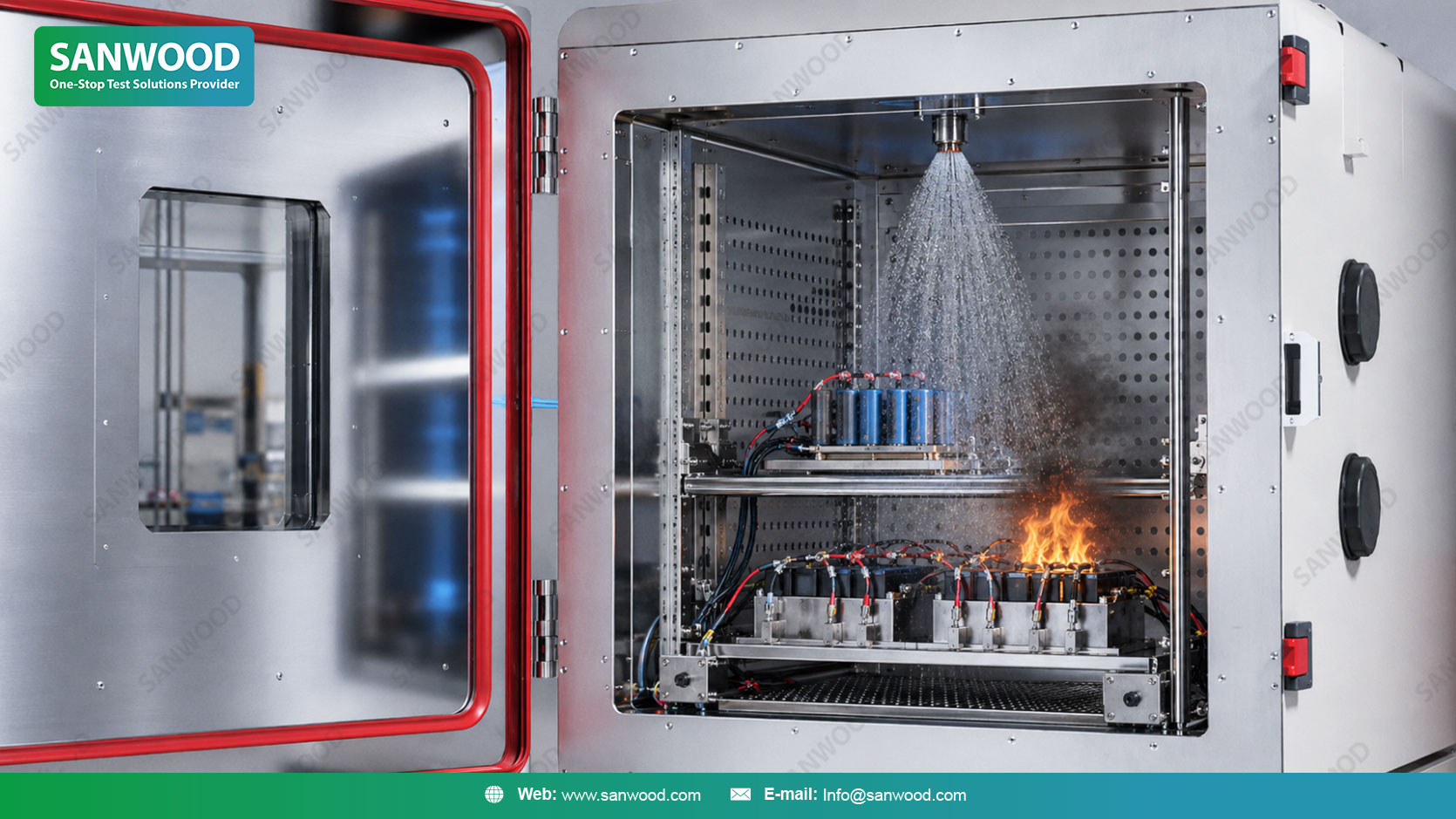
Battery test chamber safety design for EUCAR Hazard Level 0–7 scenarios focuses on how the chamber helps manage different lithium-ion battery failure risks, from normal testing conditions to venting, smoke, gas release, fire, pressure build-up or explosion-level hazards.
For EV, ESS and lithium-ion battery testing, safety design is not a single component. It is a complete system that may include reinforced structure, pressure relief, gas detection, smoke detection, emergency exhaust, fire protection interface, safety interlocks, remote monitoring and automatic shutdown logic.
A safer technical expression is:
The chamber can be configured to support EUCAR Hazard Level 0–7 testing scenarios, depending on the battery type, test method, risk level and customer safety requirements.
Avoid writing “EUCAR certified chamber” unless a specific certification document exists.
In the previous article, we explained how EUCAR Hazard Level 0–7 is used to describe lithium-ion battery failure severity, from no visible effect to explosion-level hazards.
This article takes the next step.
For engineers, the key question is not only “What does the hazard level mean?”
The more practical question is:
How should a Battery Test Chambers be designed when the test may involve venting, smoke, gas release, fire, pressure build-up or thermal runaway?
This article explains how EUCAR-related risk scenarios affect chamber structure, pressure relief, gas detection, emergency exhaust, safety interlocks and shutdown logic.
In short, EUCAR helps describe the risk. Chamber safety design helps manage that risk during testing.
EUCAR Hazard Level 0–7 is often used in battery safety discussions to describe possible failure behavior.
But chamber selection should not be based only on the level number.
A better question is:
What physical event should the chamber be prepared to handle?
For example, a low-risk cell aging test may only need temperature control, cable access and basic monitoring. A module charge-discharge test may require heat-load calculation, gas monitoring and emergency shutdown. A high-energy pack-level safety test may require reinforced structure, pressure relief, emergency exhaust, remote operation and integration with the laboratory safety system.
That is why EUCAR levels should be treated as a risk communication tool, not as a simple product label.
There is no universal safety configuration for every lithium-ion battery test.
A small cell test, a module cycling test and a high-energy pack abuse test have very different risk profiles. Chamber safety design should be selected according to the battery energy, chemistry, test method, expected failure response and laboratory safety plan.
For higher-risk tests, the chamber may require:
· Reinforced chamber body
· Pressure relief structure
· Explosion relief design
· Gas detection
· Smoke detection
· Fire detection interface
· Emergency exhaust
· Fresh air ventilation
· Door safety interlock
· Over-temperature protection
· Automatic power cut-off
· Remote operation
· Alarm and shutdown logic
For high-risk lithium-ion battery tests, Explosion-Proof Battery Test Chamber may be required to provide stronger structure and project-specific safety protection.
The chamber body should be designed according to the expected battery response and test risk level.
For routine environmental tests, a standard structure may be enough. For higher-risk battery testing, reinforced doors, stronger panels, safety locks and pressure relief paths may be required.
The purpose is not to claim that a chamber can prevent all failure events. The purpose is to reduce risk and help manage expected consequences during testing.
When lithium-ion batteries vent, they may release hot gas, smoke or pressure.
Pressure relief and emergency exhaust systems help guide abnormal gas release away from operators and sensitive equipment. The design should consider chamber volume, expected gas generation, exhaust path, laboratory ventilation and site safety requirements.
This becomes more important for ESS and BESS projects, where battery energy levels are often higher.
Gas detection, smoke detection and fire detection interfaces help identify abnormal conditions earlier.
These systems can trigger alarms, shutdown logic, emergency exhaust or communication with the laboratory safety system. The exact configuration depends on battery chemistry, test method, chamber size and laboratory risk assessment.
Door interlocks, over-temperature protection, emergency stop and automatic shutdown logic are important for operator safety and equipment protection.
For charge-discharge testing, the chamber safety system may also need to communicate with battery cyclers, power supplies or monitoring systems.
For active cycling projects, Battery Charge-Discharge Test Chamber can be configured with cable ports, monitoring interfaces and safety logic for controlled operation.
Thermal runaway is one of the most serious safety concerns in lithium-ion battery testing. It may involve rapid temperature rise, gas release, smoke, fire or explosion-level events.
EUCAR levels can help describe the severity of possible battery responses, but they do not replace a complete hazard analysis.
Before selecting a chamber, engineers should clarify:
· Is the test object a cell, module, pack or ESS unit?
· What is the battery energy level?
· Will the battery be charged or discharged inside the chamber?
· Is thermal runaway possible?
· What gas, smoke or fire response is expected?
· Does the chamber need pressure relief or explosion relief?
· What site exhaust and fire safety systems are available?
· What emergency procedure will the laboratory follow?
The next article in this series will go deeper into Thermal Runaway Test Chambers and how laboratories manage venting, fire and explosion risks during high-risk lithium-ion battery testing.
Battery safety requirements change as the test object becomes larger.
Cell testing may involve single cells or small sample groups. The chamber may need accurate temperature control, cable access and protection against smoke or gas release.
Module testing introduces higher energy, more wiring and greater heat generation. Safety design may need stronger monitoring, better exhaust planning and more attention to thermal propagation risk.
Pack-level and ESS testing often involve large, heavy and high-energy systems. For these projects, Walk-In Battery Test Chamber may be required to provide enough internal space, cable access, safety monitoring, emergency exhaust and service access.
For complete battery systems, chamber safety should be planned as part of the whole laboratory safety design.
Battery safety testing is connected to environmental testing, but the focus is different.
Environmental Test Chambers and Climatic Test Chambers are commonly used to simulate temperature, humidity and long-term environmental conditions.
When lithium-ion batteries are tested under energized or high-risk conditions, additional safety features may be required. This is where a standard chamber becomes a battery-specific chamber.
For projects that require both temperature and humidity control, Temperature Humidity Test Chamber can support combined environmental exposure. But if the test involves venting, smoke, fire or thermal runaway risk, the battery safety configuration must be reviewed separately.
Environmental control defines the test condition.
Safety design defines how the chamber helps manage risk.
Battery safety testing may be related to different standards, depending on the application and target market.
Common references may include UN 38.3, IEC 62660, ISO 12405, IEC 62619, UL 2580, UL 1973, UL 9540A and SAE J2464.
A battery test chamber does not replace these standards or complete the certification process by itself. Its role is to provide controlled test conditions, safety-controlled space and suitable chamber configuration for the battery validation workflow.
The applicable test method, chamber configuration and safety measures should be confirmed before final system design.
Safety is the main topic of this article, but long-term laboratory planning also includes refrigeration technology.
For battery laboratories in Europe and North America, low-GWP refrigeration is becoming an important consideration. CO₂ refrigerant, also known as R744, has a GWP of 1 and can be considered for suitable chamber applications.
For laboratories with sustainability or low-GWP requirements, CO₂ Refrigerant Climate Chambers may support future-ready environmental and battery testing plans.
The final refrigeration choice should still consider temperature range, cooling capacity, heat load, energy use, installation conditions and service support.
Before selecting a battery chamber for EUCAR 0–7 scenarios, engineers should define the actual test risk.
Important questions include:
· What is the test object: cell, module, pack or ESS?
· What is the battery energy level?
· Will the battery be charged or discharged inside the chamber?
· Is the test destructive or non-destructive?
· What EUCAR hazard level is expected?
· Is gas release, smoke, fire or thermal runaway possible?
· What pressure relief or exhaust capacity is required?
· Does the lab have fire suppression or exhaust infrastructure?
· What monitoring and shutdown logic is required?
· Is remote operation required?
· What installation, maintenance and training support is needed?
For battery safety testing, the right chamber is not simply the strongest model. It is the system that matches the actual risk level, test method and laboratory safety plan.
SANWOOD Technology provides Battery Test Chambers for EV batteries, lithium-ion batteries, ESS, BESS, cells, modules and packs.
Depending on project requirements, SANWOOD battery test chambers can be configured for temperature testing, humidity testing, charge-discharge testing, safety-related testing, EUCAR Hazard Level 0–7 scenarios and thermal runaway risk conditions.
Available options may include reinforced structure, pressure relief, gas or smoke detection, emergency exhaust, fire protection interface, remote monitoring, cable ports, battery cycler integration and low-GWP refrigeration systems.
For higher-risk lithium-ion battery testing, SANWOOD provides Explosion-Proof Battery Test Chambers with project-specific safety configuration. For large battery packs or energy storage systems, SANWOOD can also support Walk-In Battery Test Chambers.
SANWOOD supports global projects with installation, commissioning, operator training, preventive maintenance and after-sales technical support. For technical evaluation, chamber configuration or project consultation, please visit our Contact / Inquiry Page.
EUCAR Hazard Level 0–7 is commonly used to describe lithium-ion battery failure severity, from no visible effect to explosion-level hazard. The exact interpretation should be confirmed according to the customer’s test protocol and laboratory safety requirements.
Use this expression carefully. In most cases, it is safer to say the chamber can be configured to support EUCAR Hazard Level 0–7 testing scenarios. Do not write “EUCAR certified chamber” unless there is a specific certification document.
Important safety features may include reinforced chamber structure, pressure relief, gas detection, smoke detection, emergency exhaust, fire protection interface, safety interlock, automatic shutdown and remote monitoring.
No chamber can guarantee prevention of thermal runaway. The chamber safety system is designed to help detect abnormal conditions and manage expected consequences according to the project risk assessment.
Battery test chamber safety design is the bridge between EUCAR hazard classification and real laboratory risk control.
A well-designed chamber should not only control temperature and humidity. It should also help manage battery safety risks through reinforced structure, pressure relief, gas and smoke detection, emergency exhaust, safety interlocks, remote operation and shutdown logic.
The next article will look more closely at Thermal Runaway Test Chambers, including how laboratories manage venting, fire and explosion risks during high-risk lithium-ion battery testing.
Sanwood is not just a company; it is a commitment to delivering high-quality products that stand the test of time.

 English
 中 文
中 文


 info@sanwood.com