2026-06-26 18:37:09
After Automotive Testing Expo Europe 2026, SANWOOD shares key trends in automotive environmental testing, EV battery safety testing, climatic test chambers and reliability testing solutions for modern vehicle development.
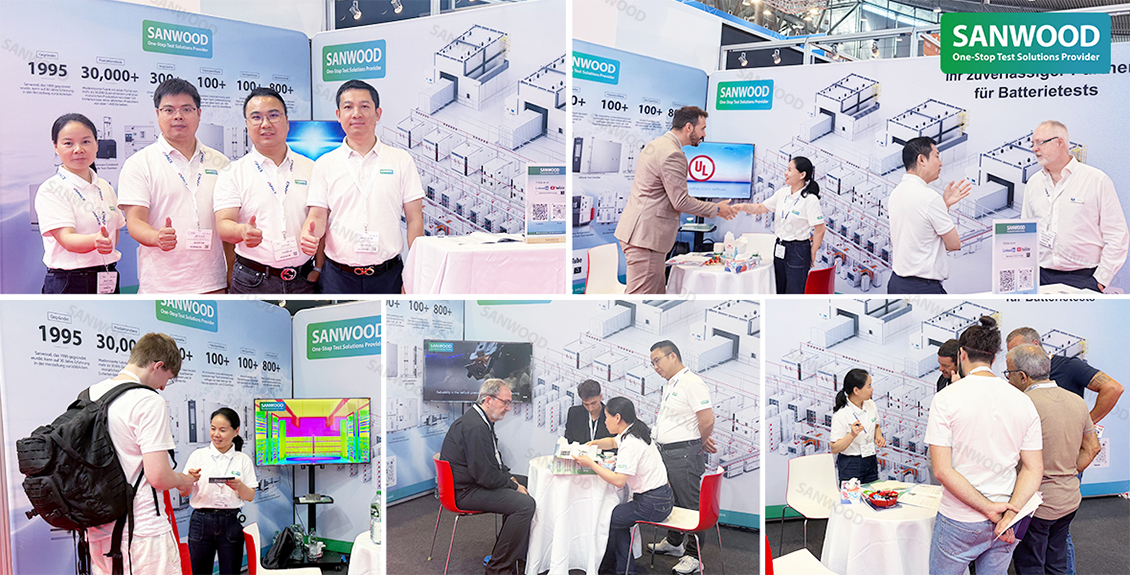
Automotive Testing Expo Europe 2026 has ended, but the technical discussions from the show are still very relevant.
For SANWOOD, the event offered a clear view of what automotive engineers are focusing on now.
The main topics were not surprising, but they were very specific:
EV battery safety.
Automotive electronics reliability.
Faster validation cycles.
More realistic environmental simulation.
Better long-term support from equipment suppliers.
These topics show why environmental test chambers, climatic test chambers and battery test chambers are becoming more important in automotive development and validation.
EV Battery Testing Needs Stronger Safety Design
EV battery testing is no longer limited to basic high and low temperature tests.
Many battery projects now involve cells, modules and packs under different temperature, humidity and electrical load conditions. Some tests may also include charge and discharge cycles, thermal abuse, over-temperature risk or thermal runaway evaluation.
For this reason, battery testing equipment must be designed around safety from the beginning.
Engineers often focus on:
Explosion-proof chamber structure
Pressure relief design
Fire detection and suppression options
Gas exhaust and ventilation
Temperature and humidity control
Integration with charge and discharge systems
Safety interlock and emergency protection
Operator and laboratory protection
SANWOOD Battery test chambers can be customized for lithium-ion battery cells, modules and packs, supporting EV battery safety testing, battery reliability testing and battery environmental simulation testing.
For battery laboratories, the chamber is not only a test environment.
It is part of the safety system.
Automotive Electronics Need Stable Climatic Testing
Modern vehicles rely heavily on electronic systems.
ECUs, VCUs, BMS units, sensors, ADAS components, displays, connectors, charging modules and power electronics all need to work under different environmental conditions.
Temperature and humidity changes can affect materials, circuits, seals, connectors and electronic stability.
That is why climatic test chambers and temperature humidity test chambers are widely used in automotive electronics testing.
These tests help engineers evaluate:
High temperature operation
Low temperature startup
Damp heat resistance
Condensation risk
Material aging
Electronic performance stability
Long-term reliability under environmental stress
For automotive electronics suppliers, stable and repeatable test conditions are essential.
A good chamber should not only reach the set point. It should control the environment accurately throughout the test.
Faster Development Cycles Require Accelerated Reliability Testing
Automotive development timelines are getting shorter.
At the same time, reliability expectations are higher.
This creates stronger demand for accelerated testing methods such as rapid temperature change testing, thermal cycling and environmental stress screening.
SANWOOD ESS rapid temperature change chambers help engineers identify potential failures earlier by exposing samples to controlled temperature transitions.
Typical applications include:
Automotive electronics screening
Power module testing
PCB assembly reliability testing
Sensor and control unit validation
Electronic component stress testing
For many engineering teams, accelerated testing is not about making the test more extreme for no reason.
It is about finding weak points before the product reaches mass production.
Thermal Shock Testing Remains Critical for Automotive Components
Automotive components often experience fast temperature changes during real use.
Examples include outdoor parking in winter, engine compartment exposure, charging system heat, rapid operation changes and climate differences between regions.
Thermal shock test chambers are used to evaluate how parts respond to sudden temperature transitions.
This is important for:
Electronic modules
Connectors
Sensors
Power devices
Sealing materials
Plastic and metal assemblies
Battery-related components
Thermal shock testing helps engineers detect risks such as cracking, deformation, solder joint weakness, sealing failure and material fatigue.
For automotive reliability testing, it remains one of the most practical ways to evaluate durability under fast environmental changes.
Customers Are Asking for Complete Testing Solutions
One strong trend from the exhibition was clear.
Customers are not only asking, “Which chamber model do you have?”
They are asking, “Can this solution work for my test project?”
That is a much better question.
A reliable automotive testing project usually requires a full review of:
Test purpose
Sample size and structure
Internal heat load
Temperature and humidity range
Ramp rate or temperature change rate
Safety requirements
Cooling system configuration
Laboratory layout
Installation conditions
Maintenance access
Operator training
Long-term service support
SANWOOD supports customers with project-based solutions, not only standard equipment supply.
This includes technical consultation, customized chamber design, installation, commissioning, training, preventive maintenance and spare parts support.
For engineering teams, this means fewer uncertainties during project planning and daily operation.
Sustainability Is Becoming Part of Equipment Selection
Environmental testing equipment often runs for long hours.
Because of this, energy efficiency and refrigerant selection are becoming more important for automotive laboratories, especially in Europe.
SANWOOD continues to develop more sustainable climate chamber solutions, including selected systems using CO₂ refrigerant R744 with GWP=1.
For customers planning long-term laboratory investment, this can help support both testing performance and environmental responsibility.
Sustainability should not reduce testing accuracy.
The goal is to achieve reliable temperature and humidity control while reducing long-term environmental impact where possible.
SANWOOD’s Automotive Testing Solutions
SANWOOD provides a wide range of testing chambers for automotive reliability testing and environmental simulation testing.
Main solutions include:
Environmental Test Chambers
Climatic Test Chambers
Temperature Humidity Test Chambers
High and Low Temperature Test Chambers
Customized Automotive Testing Solutions
These solutions support EV battery testing, automotive electronics testing, reliability testing, environmental stress screening, thermal cycling and climatic simulation testing.
Moving Forward After Automotive Testing Expo Europe 2026
Automotive Testing Expo Europe 2026 confirmed one thing for us:
Automotive testing is becoming more technical, more safety-focused and more project-specific.
Standard equipment is still important, but many customers now need customized solutions that match their exact testing conditions.
SANWOOD will continue to work with automotive manufacturers, battery companies, Tier 1 suppliers and test laboratories to provide reliable testing chambers and practical engineering support.
If your team is planning a new automotive environmental testing project, SANWOOD can help review the test conditions and provide a suitable chamber solution.
Sanwood is not just a company; it is a commitment to delivering high-quality products that stand the test of time.

 English
 中 文
中 文



 info@sanwood.com