2026-06-25 10:28:19
What Is EUCAR Hazard Level 0–7?
EUCAR Hazard Level 0–7 is used to describe the severity of a lithium-ion battery failure after safety testing, abuse testing, or abnormal operating conditions.
In simple terms, it tells engineers what actually happened during the test.
Did the battery remain stable?
Did it leak?
Did it vent gas?
Did fire, rupture, or explosion occur?
These results directly affect how a battery test chamber should be designed. A chamber used for basic temperature cycling is very different from one used for overcharge testing, thermal runaway evaluation, or high-risk battery abuse testing.
That is why EUCAR Hazard Level is closely related to the selection of a battery test chamber, environmental test chamber, or climatic test chamber for lithium-ion battery cells, modules, and packs.
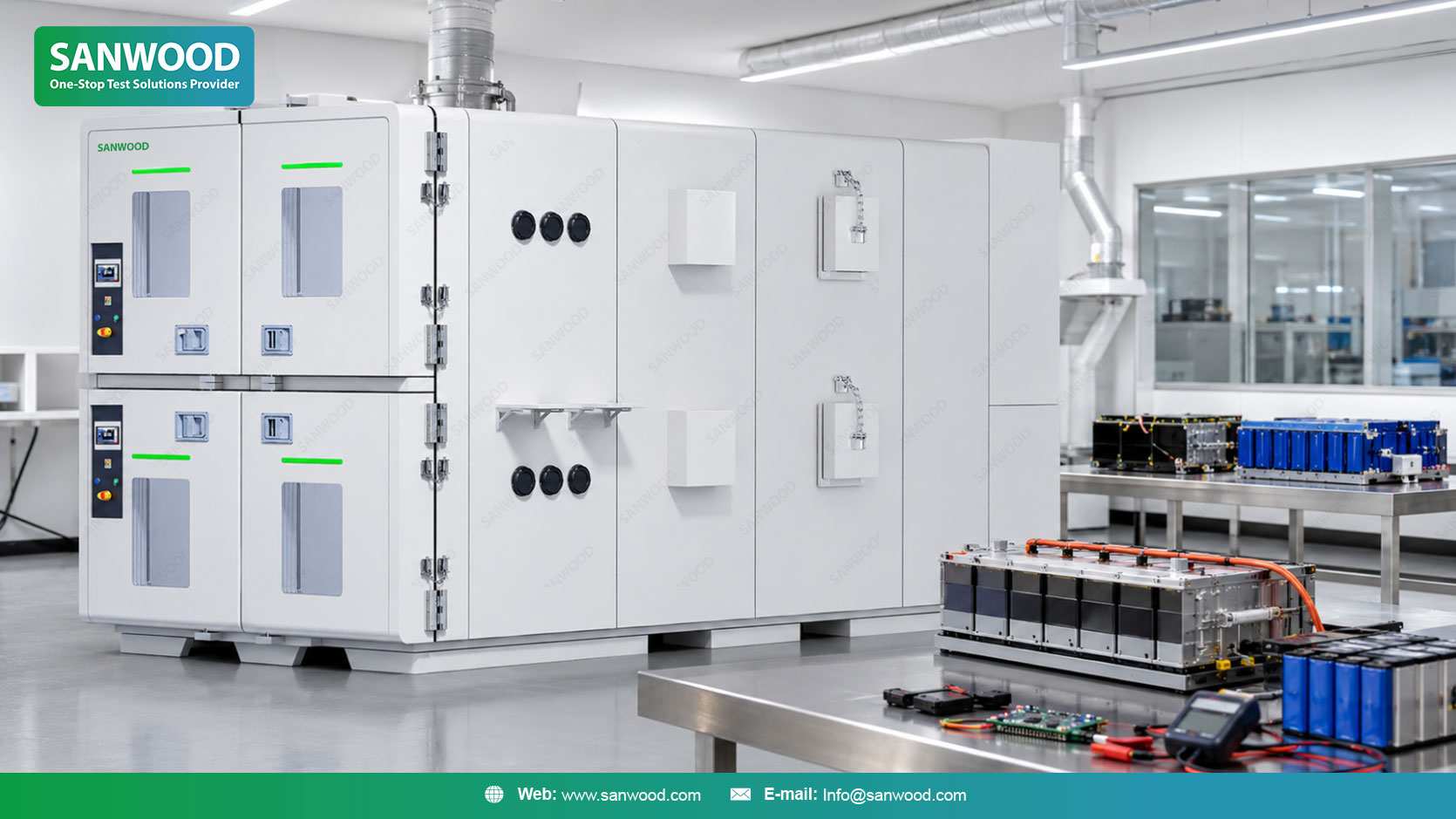
Lithium-ion batteries are often tested beyond normal operating limits. High temperature, low temperature, overcharge, external short circuit, thermal abuse, charge-discharge cycling, and combined environmental stress can all expose potential safety risks.
When the expected result is low-risk, temperature control and data recording may be the main concerns.
When the test may involve venting, fire, rupture, or explosion, the chamber becomes part of the safety system.
EUCAR Hazard Level helps clarify several practical questions before a project starts:
· What failure result could occur during testing?
· Is there a risk of gas release, flame, rupture, or explosion?
· Does the chamber need pressure relief or emergency exhaust?
· Should CO, H₂, VOC, or smoke detection be included?
· Is the sample a cell, module, pack, or complete ESS battery system?
· Will the chamber be connected with charge-discharge equipment?
This is why EUCAR Hazard Level is often considered together with battery safety standards such as SAE J2464, UN 38.3, IEC 62660, ISO 12405, UL 2580, UL 9540A, and IEC 62619.
EUCAR Level | General Result | Meaning for Battery Testing |
Level 0 | No effect | No visible safety issue after testing |
Level 1 | Minor response | Battery protection may activate, without serious failure |
Level 2 | Damage or defect | Visible damage may occur, but without leakage, fire, or explosion |
Level 3 | Leakage | Electrolyte leakage may occur |
Level 4 | Venting | Gas or electrolyte venting may occur |
Level 5 | Fire or flame | Fire occurs, but without explosion |
Level 6 | Rupture | Casing rupture or flying parts may occur |
Level 7 | Explosion | Severe failure, explosion, or cell disintegration |
The higher the EUCAR level, the more important chamber safety design becomes.
A chamber for Level 2 or Level 3 risk may focus on containment, monitoring, and basic protection. A chamber for possible Level 5, Level 6, or Level 7 scenarios needs a much more serious safety design.
A standard temperature chamber may be suitable for routine battery performance testing. But high-risk lithium-ion battery safety testing usually requires a dedicated battery test chamber.
Depending on the expected hazard level, the chamber may need:
· Reinforced chamber structure
· Explosion-proof or pressure-relief design
· Smoke detection
· CO, H₂, or VOC gas detection
· Emergency exhaust system
· Door safety interlock
· Fire suppression interface
· Over-temperature protection
· Cable ports for charge-discharge testing
· Remote monitoring and automatic shutdown
For EV battery modules and packs, the design becomes more complex. Heat load, cable routing, BMS signal connection, airflow distribution, fixture design, and compatibility with battery cyclers all need to be reviewed before chamber selection.
SANWOOD battery test chambers can be configured according to the test object, expected risk level, temperature range, humidity requirements, test method, and laboratory safety needs.
Learn more about SANWOOD Battery Test Chambers.
Different battery samples require different test chamber solutions.
Battery cell testing usually focuses on material behavior, thermal stability, charge-discharge performance, and early safety validation. A compact chamber with accurate temperature control, cable ports, safety interlock, and optional gas detection is often required.
Battery module testing brings higher heat load, larger sample size, more cables, and more monitoring points. The chamber may need stronger cooling capacity, better airflow, emergency exhaust, and multi-channel data access.
Battery pack testing is closer to real application conditions. EV battery packs, ESS battery packs, and liquid-cooled battery systems may require a walk-in chamber, load-bearing floor, customized fixtures, charge-discharge integration, and stronger safety protection.
For large battery systems, SANWOOD provides walk-in battery test chambers and customized solutions for EV and energy storage battery testing.
Battery safety testing is not only about abuse conditions.
Long-term exposure to temperature, humidity, thermal cycling, and rapid temperature change can affect seals, insulation, connectors, BMS electronics, pack structure, and overall battery reliability.
A well-designed environmental test chamber or climatic test chamber helps evaluate:
· High-temperature aging
· Low-temperature performance
· Temperature cycling
· Damp heat resistance
· Thermal stress
· Battery pack reliability
· Performance under changing climate conditions
This type of testing is especially important for EV batteries and energy storage systems used in different climates and markets.
EUCAR Hazard Level helps classify the test result. International standards define test methods, procedures, and safety requirements.
Standard | Common Application |
SAE J2464 | Abuse testing for EV and hybrid vehicle battery systems |
UN 38.3 | Lithium battery transport safety testing |
IEC 62660 | Lithium-ion cells for electric road vehicles |
ISO 12405 | Battery packs and systems for electric vehicles |
UL 2580 | Batteries for use in electric vehicles |
UL 9540A | Thermal runaway fire propagation testing for energy storage systems |
IEC 62619 | Safety requirements for industrial lithium batteries |
Before choosing a chamber, it is not enough to check only the temperature range. Chamber volume, heat load, safety configuration, exhaust design, cable access, test integration, and applicable standards should all be reviewed together.
Contact SANWOOD Technology for lithium-ion battery testing solutions.
SANWOOD Technology provides battery test chambers and environmental simulation solutions for lithium-ion battery cells, modules, packs, EV batteries, and energy storage systems.
Available solutions include:
· Battery explosion-proof test chambers
· Battery charge-discharge test chambers
· Double-layer battery test chambers
· Multi-layer battery test chambers
· Walk-in battery test chambers
· High and low temperature battery test chambers
· Temperature humidity battery test chambers
· Liquid-cooled battery test chambers
· Customized environmental and climatic test chambers
For demanding battery safety testing, SANWOOD can configure the chamber with pressure relief, smoke detection, gas detection, emergency exhaust, door interlock, fire protection interface, remote monitoring, and automatic shutdown.
For Europe and other markets with stricter sustainability requirements, SANWOOD also supports low-GWP refrigeration options, including CO₂ refrigerant R744 with GWP=1.
Learn more about CO₂ Refrigerant Climate Chambers.
With a 30,000 m² manufacturing base, global project experience, and worldwide installation and maintenance support, SANWOOD helps laboratories build safer and more reliable battery testing systems.
EUCAR Hazard Level 0–7 gives engineers a clear way to describe battery failure severity during lithium-ion battery safety testing.
More importantly, it helps define the right chamber configuration.
For basic temperature and humidity testing, an environmental test chamber or climatic test chamber may be enough. For thermal runaway, overcharge, abuse testing, rupture, or explosion-risk scenarios, a dedicated battery test chamber with stronger safety protection is recommended.
SANWOOD Technology provides customized battery test chamber solutions for EV battery, ESS battery, lithium-ion cell, module, and pack testing. From chamber design and manufacturing to installation and after-sales support, SANWOOD helps engineers improve safety, reliability, and testing efficiency.
Request a solution from SANWOOD Battery Testing Experts.
EUCAR Hazard Level 0–7 is a classification method used to describe the severity of lithium-ion battery failure during safety or abuse testing, from no effect to explosion.
Because different hazard levels require different chamber safety designs, such as gas detection, emergency exhaust, pressure relief, door interlock, fire protection interface, and remote monitoring.
Yes, for basic temperature or humidity testing. For thermal runaway, overcharge, or abuse testing, a dedicated battery test chamber is recommended.
Common standards include SAE J2464, UN 38.3, IEC 62660, ISO 12405, UL 2580, UL 9540A, and IEC 62619.
Yes. SANWOOD can configure battery test chambers based on test object, expected risk level, temperature and humidity requirements, heat load, cable access, and laboratory safety needs.
Sanwood is not just a company; it is a commitment to delivering high-quality products that stand the test of time.

 English
 中 文
中 文


 info@sanwood.com