2026-06-24 14:22:19
High and low temperature battery test chamber is used to test lithium-ion battery cells, modules and packs under controlled hot and cold conditions.
For EV batteries, ESS batteries and lithium-ion battery systems, temperature testing helps engineers understand how batteries perform in real operating environments. Cold weather, hot climates, fast charging, long-term cycling and thermal stress can all affect battery capacity, efficiency, aging and safety.
Compared with a standard temperature chamber, a battery test chamber needs more than temperature control. It may also require cable ports, charge-discharge support, heat load calculation, safety protection, gas or smoke detection, emergency exhaust and remote monitoring.
This is why high and low temperature testing is an important part of modern Battery Test Chambers and battery reliability validation.
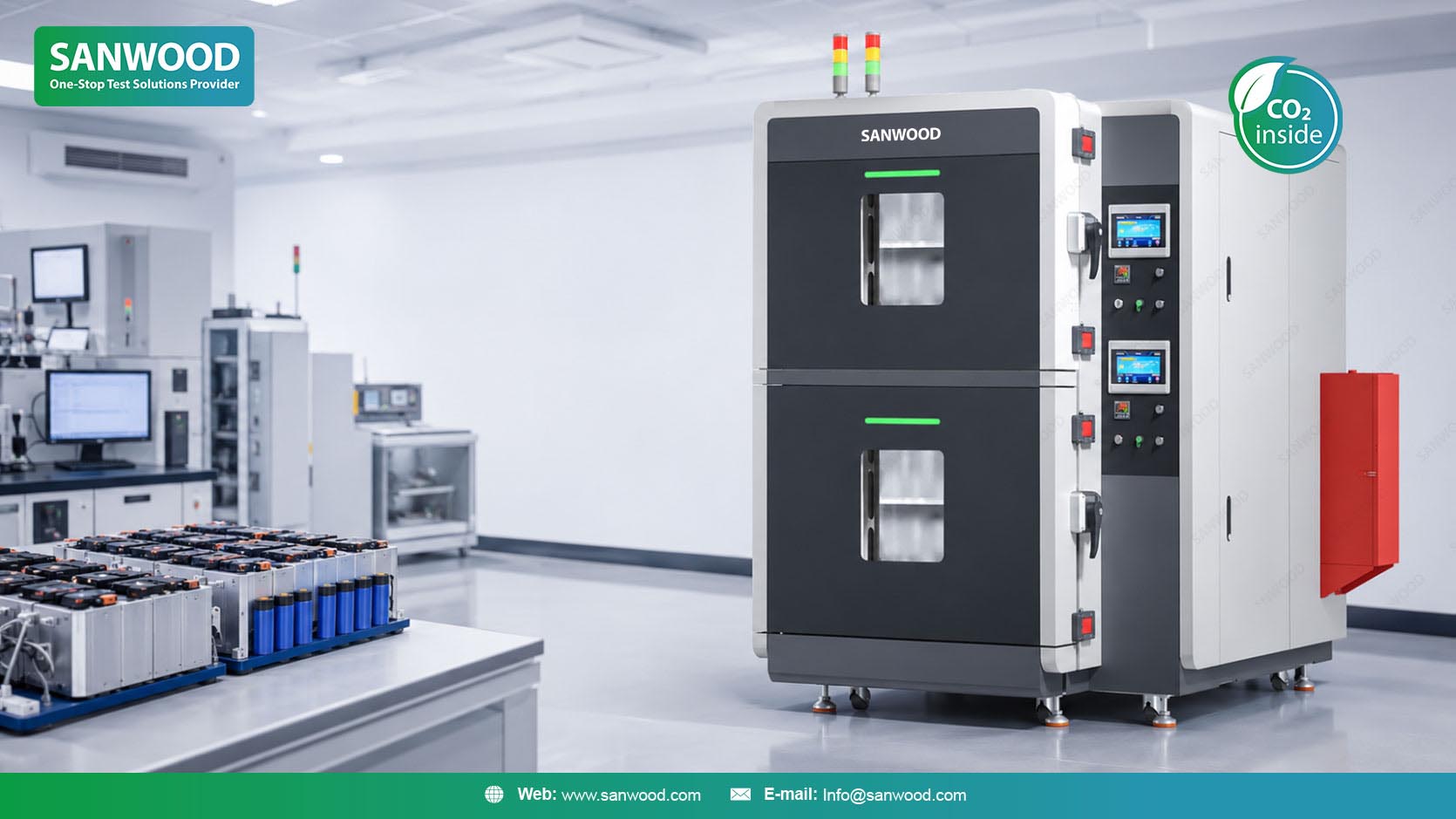
Battery performance changes with temperature.
At low temperatures, lithium-ion batteries may show reduced capacity, slower charging, higher internal resistance and cold-start issues. At high temperatures, batteries may age faster, while electrolytes, separators, sealing materials, sensors, BMS components and pack structures may also be affected.
High and low temperature testing helps engineers evaluate capacity change, charge-discharge performance, aging behavior, thermal stability, pack sealing, BMS response and safety behavior under thermal stress.
For EV, ESS and BESS applications, these results are important because batteries may operate in different climates, outdoor environments and demanding charging conditions.
Test Object | Common Purpose | Chamber Focus |
Battery Cells | Material evaluation, cell development, sample comparison | Accurate temperature control, stable airflow, safe cable access |
Battery Modules | Module balance, insulation, heat generation during cycling | Larger space, cable ports, monitoring access, safety protection |
Battery Packs | EV pack and ESS system validation | Cooling capacity, heat load calculation, safety design, service access |
Large ESS/BESS Systems | System-level and long-duration testing | Walk-in structure, custom size, safety logic, installation planning |
For large battery packs or energy storage systems, Walk-In Battery Test Chambers are often used for system-level testing.
Chamber selection should not be based only on temperature range.
A chamber may reach the target temperature under empty-load conditions. But when batteries are charged and discharged inside the chamber, they generate heat. This directly affects temperature stability, recovery time and safety risk.
Before choosing a battery test chamber, engineers should confirm battery size, weight, energy level, charge-discharge current, heat generation, test duration, temperature change rate, cable layout and safety requirements.
For cycling tests, Battery Charge-Discharge Test Chambers can be configured with cable ports, monitoring interfaces and safety logic for integration with battery cyclers.
High temperature testing is used for high temperature storage, discharge, thermal aging, material stability, BMS performance and pack sealing reliability.
Low temperature testing helps evaluate reduced capacity, discharge efficiency, internal resistance, charging behavior, cold-start performance, connector reliability and sealing performance.
For EV batteries, these tests help verify performance in hot climates, winter driving and fast charging conditions. For ESS and BESS systems, they help evaluate long-term operation in outdoor or semi-outdoor environments.
Lithium-ion battery testing requires careful safety planning.
Under abnormal conditions, batteries may release gas, smoke or heat. In serious cases, thermal runaway, fire or pressure release may occur.
Depending on the battery type and test risk level, a high and low temperature battery test chamber may include reinforced structure, pressure relief, smoke or gas detection, emergency exhaust, door safety interlock, over-temperature protection, emergency stop, remote monitoring and alarm shutdown logic.
For higher-risk testing, Explosion-Proof Battery Test Chambers may be required.
High and low temperature battery testing is often part of a wider validation process.
Depending on the battery type, application and target market, engineers may refer to standards such as IEC 62660, ISO 12405, IEC 62619, UL 2580, UN 38.3 and SAE J2464.
A battery test chamber does not complete certification by itself. Its role is to provide controlled temperature conditions, safe test space and suitable chamber configuration for battery validation.
Key Question | Why It Matters |
Cell, module or pack? | Determines size, airflow, cable access and safety level |
Charge-discharge testing? | Affects heat load and cycler integration |
Required temperature range? | Defines heating and cooling capacity |
Expected heat load? | Impacts stability and recovery time |
Humidity required? | May require a Temperature Humidity Test Chamber |
Safety functions needed? | Depends on battery energy level and risk assessment |
Standards to support? | Helps match validation requirements |
Service support available? | Important for long-term lab operation |
The right chamber is not simply the largest or fastest model. It is the chamber that matches the battery type, test condition, heat load, safety risk and laboratory operation.
SANWOOD Technology provides high and low temperature Battery Test Chambers solutions for lithium-ion cells, modules, packs, EV batteries, ESS batteries and new energy testing laboratories.
SANWOOD chambers can be configured for high temperature testing, low temperature testing, temperature cycling, charge-discharge testing, module testing, pack testing and walk-in battery testing.
Available options may include customized chamber size, cable ports, reinforced safety design, pressure relief, smoke or gas detection, emergency exhaust, remote monitoring, battery cycler integration and low-GWP refrigeration solutions.
For laboratories with sustainability requirements, CO₂ Refrigerant Climate Chambers can also be considered as part of a low-GWP refrigeration strategy.
SANWOOD supports global projects with installation, commissioning, operator training, preventive maintenance and after-sales service.
What is a high and low temperature battery test chamber?
It simulates hot and cold conditions for lithium-ion battery cells, modules and packs to evaluate performance, reliability and safety.
Can batteries be charged and discharged inside the chamber?
Yes, if the chamber includes cable ports, heat load planning, safety monitoring and battery cycler integration.
Does high and low temperature testing include humidity?
Not always. If humidity exposure is required, a Temperature Humidity Test Chamber or Climatic Chamber should be selected.
What safety features are important?
Pressure relief, gas detection, smoke detection, emergency exhaust, door interlock, over-temperature protection, emergency stop and remote monitoring are common options.
Can a battery test chamber complete certification by itself?
No. Certification depends on the full test method, laboratory qualification and applicable standard requirements.
High and low temperature battery test chambers help engineers evaluate battery performance, aging, reliability and safety under real operating conditions.
For EV, ESS and BESS applications, chamber selection should consider temperature range, battery size, heat load, charge-discharge conditions, safety risk, target standards and long-term service support.
SANWOOD Technology provides configurable Battery Test Chambers for cells, modules, packs, charge-discharge testing, safety protection, walk-in testing, low-GWP refrigeration and global service support.
Sanwood is not just a company; it is a commitment to delivering high-quality products that stand the test of time.

 English
 中 文
中 文


 info@sanwood.com