2026-06-17 10:19:03
A battery test chamber is an environmental and safety testing system designed to simulate high temperature, low temperature, humidity, thermal cycling and safety-related test conditions for lithium-ion battery cells, modules, packs, EV batteries and energy storage systems.
For EV, ESS and BESS battery manufacturers, SANWOOD battery test chambers help engineers evaluate battery performance, reliability and safety under controlled environmental conditions. Depending on the project configuration, the chamber can support temperature and humidity simulation, charge-discharge testing, thermal stress validation and safety-related scenarios such as venting, smoke, gas release, fire risk and thermal runaway.
As battery systems become larger, more powerful and more widely used in electric vehicles and energy storage applications, chamber design must combine accurate environmental control, multi-level safety protection, low-GWP refrigeration options and long-term service support.
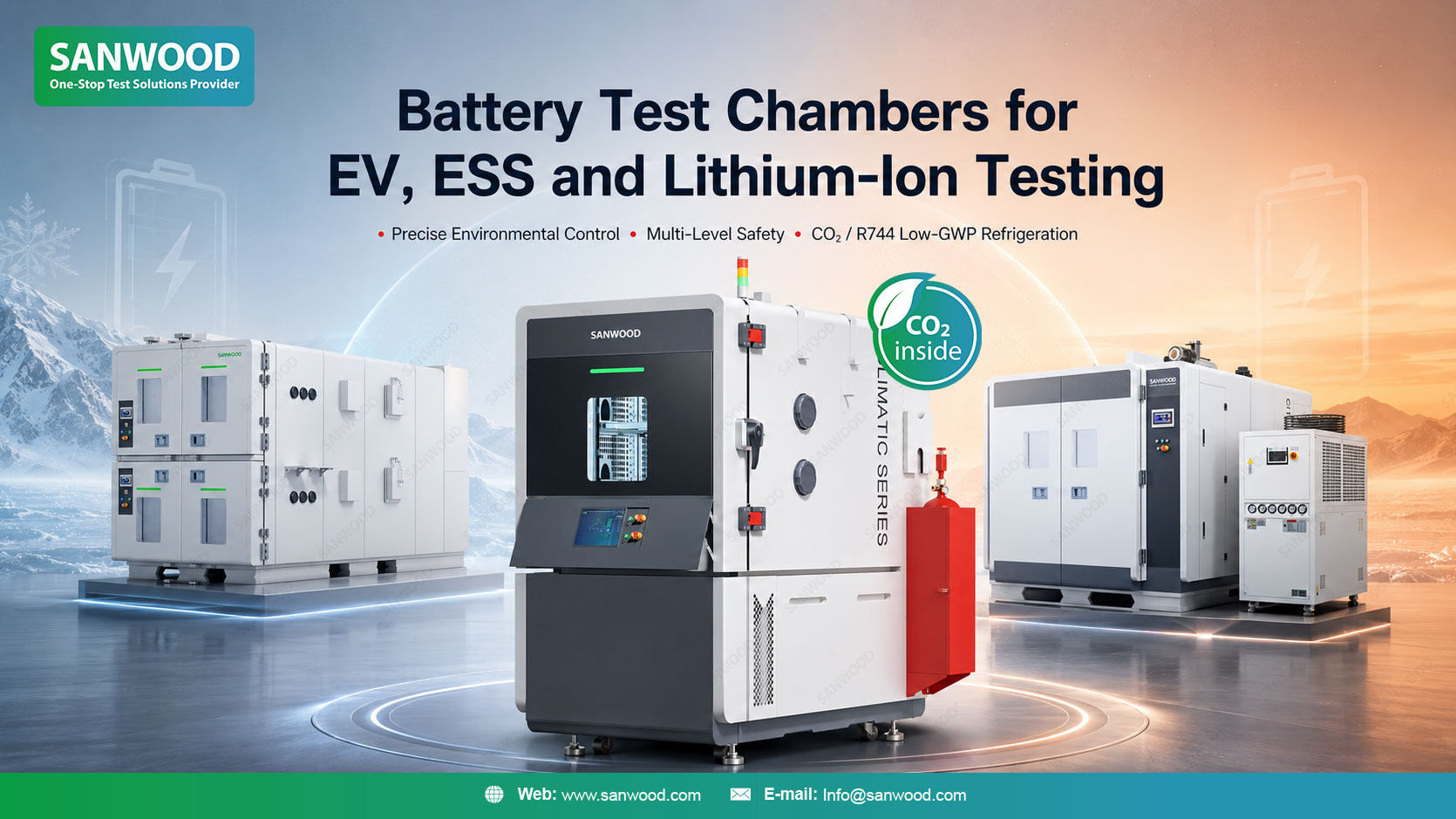
A battery test chamber is a controlled test environment used to evaluate batteries under specific temperature, humidity and safety conditions.
Unlike a standard temperature humidity chamber, a battery test chamber is designed around the risk profile of lithium-ion batteries. During charging, discharging, aging, abuse testing or failure simulation, batteries may generate heat, release gas, swell, vent, catch fire or, in extreme cases, explode.
For this reason, battery test chambers usually require more than basic temperature and humidity control. Depending on the application, they may include explosion-proof structure, pressure relief, smoke detection, gas monitoring, emergency exhaust, fire protection interface, door safety interlock, over-temperature protection and remote monitoring.
For battery laboratories, the goal is clear: create a stable and repeatable test environment while reducing operational risk.
Lithium-ion batteries are widely used in electric vehicles, energy storage systems, automotive electronics, industrial equipment and high-power electronic systems. These applications operate in different climates, load conditions and safety environments.
A battery that performs well at room temperature may behave differently at -40°C, +60°C or under long-term high-humidity exposure. Thermal stress can affect capacity, internal resistance, charging efficiency, cycle life and safety performance.
For EV, ESS and BESS projects, battery test chambers help engineers answer key questions:
· Can the battery operate safely in hot and cold climates?
· How does humidity affect long-term reliability?
· What happens during charge and discharge under thermal stress?
· Can the battery pack remain stable after repeated thermal cycling?
· How should the test lab manage venting, fire, gas release or thermal runaway risk?
· Is the chamber suitable for cells, modules, packs or complete energy storage systems?
This is why battery test chambers are used across R&D, validation, quality control and certification-related testing.
For electric vehicles, batteries must perform reliably across changing climates, charging behaviors and road conditions.
Typical test objects include battery cells, modules, packs, EV power battery systems, thermal management systems and BMS validation setups.
Common test conditions include high and low temperature testing, temperature cycling, temperature humidity testing, charge and discharge under controlled temperature, long-term aging and pack-level environmental reliability testing.
ESS and BESS systems are used in grid storage, renewable energy storage, commercial energy storage and residential battery systems.
Compared with small batteries, ESS and BESS systems often have larger energy capacity and higher safety requirements. For this reason, test chambers for ESS and BESS projects must pay close attention to thermal runaway risk, gas release, fire propagation, emergency exhaust and chamber safety design.
For this market, common search and application terms include:
· ESS battery test chamber
· BESS battery test chamber
· Battery energy storage testing
· Thermal runaway test chamber
· Energy storage safety testing
Battery testing requirements change significantly depending on the test object.
Cell testing focuses on basic electrochemical behavior, capacity, aging and safety response.
Module testing introduces heat distribution, wiring, connection reliability and thermal propagation concerns.
Pack testing requires larger test space, higher heat load management, cable ports, safety monitoring and stronger chamber structure.
For large EV battery packs and energy storage systems, walk-in battery test chambers are often required.
A professional battery test chamber should support the real testing needs of battery engineers, not only basic temperature control.
High and low temperature testing helps evaluate cold-start performance, low-temperature charging behavior, high-temperature discharge stability, thermal aging, BMS response and safety performance under extreme climates.
For EV batteries, this is especially important because vehicles may be used in very cold regions, desert climates or high-temperature fast-charging environments.
Humidity can affect battery enclosures, terminals, insulation materials, sealing structures, connectors and electronic components.
Temperature humidity battery test chambers are used to simulate long-term exposure to humid climates. This is important for automotive battery packs, ESS containers, outdoor energy storage systems and battery electronics.
The purpose is not only to test the battery cell itself, but also to evaluate the reliability of the full battery system.
Many battery tests require the battery to be charged or discharged inside the chamber.
This requires cable ports, safe wiring design, compatibility with battery cyclers, heat load calculation, ventilation, emergency stop logic and temperature monitoring.
A battery charge-discharge test chamber must have enough cooling capacity to manage both the chamber load and the heat generated by the battery during cycling.
Thermal runaway is one of the most serious safety risks in lithium-ion battery testing. It may involve rapid temperature rise, gas release, smoke, fire or explosion.
A battery test chamber used for high-risk testing should be designed according to the expected hazard level. Important safety functions may include reinforced structure, pressure relief, smoke and gas detection, emergency exhaust, fire protection interface, remote operation, safety interlock and abnormality alarm.
For this reason, battery test chamber selection should not be based only on temperature range and chamber size. Safety design is just as important.
For lithium-ion battery safety testing, EUCAR Hazard Level 0–7 is commonly used to describe the severity of battery failure events. The exact interpretation should be confirmed according to the customer’s test protocol and project requirements.
For battery test chambers, EUCAR Hazard Level is important because different hazard levels require different safety designs. A chamber used for routine temperature cycling may not need the same protection level as a chamber used for high-risk abuse testing.
A safer technical expression is:
The chamber can be configured to support EUCAR Hazard Level 0–7 testing scenarios, depending on the actual test object, risk level and customer safety requirements.
Avoid writing “EUCAR certified chamber” unless a specific certification document exists.
Battery test chambers are commonly used to support test environments related to international battery testing requirements.
Commonly referenced standards and test methods include:
· UN 38.3
· IEC 62660
· IEC 62619
· IEC 62133
· UL 2580
· UL 1973
· UL 9540A
· SAE J2464
· SAE J2929
· UNECE R100
· ISO 12405
· EUCAR Hazard Level 0–7
A battery test chamber provides the environmental and safety-controlled test space. It does not replace the complete test method, battery cycler, abuse test equipment, fire safety system, laboratory procedure or third-party certification process.
This distinction is important for EV, ESS and BESS testing projects, especially when chambers are used as part of a larger validation or certification workflow.
For European and U.S. markets, refrigerant choice is becoming more important.
Traditional refrigeration systems may use high-GWP refrigerants. For laboratories and manufacturers facing long-term carbon reduction pressure, low-GWP refrigeration is becoming a stronger purchasing consideration.
CO₂ refrigerant, also known as R744, has a GWP of 1 because CO₂ is used as the reference gas for global warming potential. For battery test chambers, a CO₂ / R744 refrigerant system can help laboratories move toward lower-GWP refrigeration and more sustainable test lab operation.
For battery laboratories in Europe, this makes CO₂ refrigerant battery test chambers, R744 battery test chambers and low-GWP environmental test chambers important topics for future planning.
When selecting a battery test chamber, engineers should not only compare price or chamber volume. A better selection process should include test requirements, safety configuration, heat load, compliance needs, service support and future operating cost.
Start with the battery level:
· Cell
· Module
· Pack
· ESS unit
· BESS system
· Liquid-cooled battery pack
· Automotive battery system
The size, heat load, wiring method and safety design will be different for each level.
Important parameters include temperature range, humidity range, temperature change rate, temperature uniformity, cooling capacity under load, heating capacity and long-term operation stability.
For battery testing, the heat generated during charge and discharge must be calculated carefully. This is especially important for battery packs, ESS units and high-power test conditions.
Before choosing a chamber, the lab should clarify the expected risk level.
Key questions include:
· Is the test only environmental reliability testing?
· Will the battery be charged or discharged inside the chamber?
· Is thermal runaway possible?
· Will abuse testing be performed?
· Is there a risk of fire, smoke, gas release or explosion?
· Is EUCAR Hazard Level 0–7 coverage required?
· Does the chamber need an explosion-proof structure?
This step directly affects chamber structure, safety system design and test lab layout.
For EV battery, ESS and BESS testing projects, the chamber supplier’s service capability is just as important as the equipment itself.
Battery test chambers often require professional installation, commissioning, safety inspection, operator training, preventive maintenance and long-term technical support. This is especially important for walk-in battery test chambers, explosion-proof battery chamber and CO₂ refrigerant battery test chambers.
For international projects in Europe, North America and other global markets, strong after-sales support helps reduce downtime, improve equipment safety and protect long-term testing investment.
SANWOOD Technology provides battery test chamber solutions for EV batteries, lithium-ion batteries, ESS, BESS, automotive batteries and new energy laboratories.
SANWOOD battery test chambers can be configured for high and low temperature testing, temperature humidity testing, charge-discharge testing, battery cell, module and pack testing, walk-in battery pack testing, explosion-proof battery safety testing, thermal runaway risk scenarios, EUCAR Hazard Level 0–7 testing scenarios and CO₂ / R744 low-GWP refrigeration systems.
Depending on project requirements, SANWOOD can also support dual-layer and multi-layer chamber structures, liquid-cooled battery testing applications, customized safety configurations and integration with battery cyclers or laboratory monitoring systems.
For customers in Europe, North America and other global markets, SANWOOD supports project-based customization, on-site installation, commissioning, preventive maintenance, operator training and after-sales technical support. This helps battery manufacturers and testing laboratories reduce downtime, improve equipment safety and protect long-term testing investment.
Common battery test chamber types include temperature battery test chambers, temperature humidity battery test chambers, explosion-proof battery test chambers, walk-in battery test chambers, battery charge-discharge test chamber, liquid-cooled battery test chamber, dual-layer or multi-layer battery test chambers and CO₂ refrigerant battery test chambers.
A battery test chamber is used to test battery cells, modules, packs and energy storage systems under controlled temperature, humidity and safety conditions. It helps evaluate performance, reliability, aging behavior and safety response under different environmental stresses.
A standard environmental test chamber mainly controls temperature and humidity. A battery test chamber adds safety protection for lithium-ion battery testing, such as reinforced structure, pressure relief, gas detection, smoke detection, fire protection interface and emergency exhaust.
Yes. A battery test chamber can be designed with cable ports, wiring channels and safety systems to work with battery cyclers. The chamber must have enough cooling capacity to handle the heat generated during charging and discharging.
EUCAR Hazard Level 0–7 is used to describe the severity of battery failure behavior, from no effect to explosion-level hazard. For battery test chambers, the expected hazard level affects the required safety design.
CO₂ refrigerant, also known as R744, has a GWP of 1. It helps battery laboratories reduce dependence on high-GWP refrigerants and supports low-carbon testing strategies, especially in European markets.
Conclusion
A battery test chamber is a critical part of EV, ESS and lithium-ion battery testing. It helps engineers simulate high temperature, low temperature, humidity, charge-discharge conditions and safety-related risks in a controlled environment.
For modern battery laboratories, the best chamber is not only accurate. It must also be safe, flexible, serviceable and ready for future low-carbon requirements.
SANWOOD battery test chambers are designed for battery cells, modules, packs, EV batteries, ESS and BESS applications, with options for temperature humidity control, explosion-proof safety design, EUCAR Hazard Level 0–7 testing scenarios, CO₂ / R744 low-GWP refrigerant systems and global service support.
If your laboratory is planning a battery testing project for EV, ESS, BESS or lithium-ion battery validation, SANWOOD can help evaluate chamber size, temperature range, humidity requirements, safety configuration, EUCAR hazard level, CO₂ refrigerant options and installation conditions.
Contact SANWOOD Technology to discuss a battery test chamber solution for your testing requirements.
Sanwood is not just a company; it is a commitment to delivering high-quality products that stand the test of time.

 English
 中 文
中 文


 info@sanwood.com