2026-03-27 15:03:07
Addressing the harsh operating environment of ECUs, Sanwood Technology's independently developed rapid temperature change test chamber strictly adheres to domestic and international environmental testing standards such as MIL-STD-2164, GJB-1032-90, GB/T 2423, and IEC 60068-2-14. With precise environmental stress screening capabilities, it ensures reliable operation of the ECU throughout its entire lifecycle.
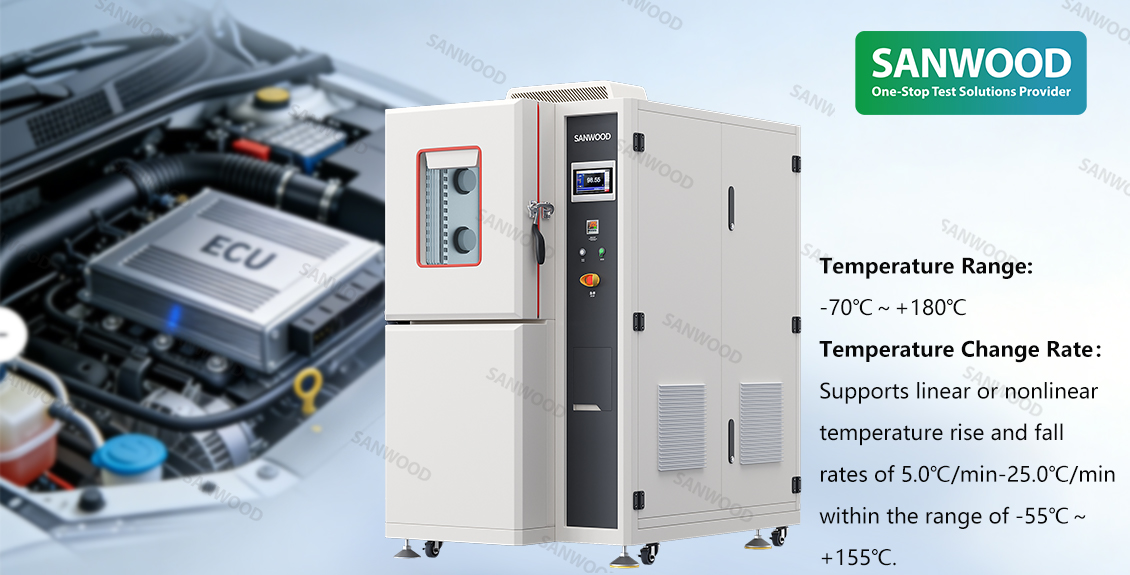
In the wave of automotive electrification and intelligentization, the Electronic Control Unit (ECU), as the core control system of the entire vehicle, shoulders critical responsibilities such as power regulation, vehicle stability, and safety assurance. Addressing the harsh operating environment of ECUs, Sanwood Technology's independently developed Rapid-Rate Temperature Change Chambers strictly adheres to domestic and international environmental testing standards such as MIL-STD-2164, GJB-1032-90, GB/T 2423, and IEC 60068-2-14. With precise environmental stress screening capabilities, it ensures reliable operation of the ECU throughout its entire lifecycle.
Challenge: Hidden Dangers Under Extreme Temperature Differences
Vehicle driving scenarios are complex and varied, and the temperature range of the environment in which the ECU operates is extremely harsh: during cold winter starts, the ambient temperature can drop to -40℃; in summer, high temperatures combined with continuous engine operation can cause the cabin temperature to soar above 125℃. The rapid temperature fluctuations during day and night cycles and hot/cold start-stop cycles create enormous temperature stress.
Core components such as PCB boards, chips, and connector solder joints have different coefficients of thermal expansion. Repeated thermal expansion and contraction can generate accumulated stress internally, easily leading to problems such as solder joint fatigue cracking, material aging, poor contact, and signal failure. Even minor damage can gradually expand, eventually causing vehicle malfunctions and creating serious safety hazards. To ensure ECU reliability throughout its entire life cycle, from R&D and mass production to vehicle use, rigorous environmental simulation testing is essential.
Equipment:The Core Capability of the Rapid-Rate Temperature Change Chambers
Sanwood Technology's Rapid-Rate Temperature Change Chambers can apply rapid temperature stress to ECUs, screening for environmental stress and accurately exposing potential defects in design, materials, or production processes. The main technical parameters are as follows:
Temperature range: -70℃~+180℃
Temperature fluctuation: ≤±0.5℃ (no load, constant state)
Temperature deviation: ≤±2℃ (no load, constant state)
Temperature change rate: Supports linear or nonlinear temperature rise and fall rates of 5.0℃/min, 10.0℃/min, 15.0℃/min, 20.0℃/min, and 25.0℃/min within the range of -55℃~+155℃.
The equipment complies with domestic and international environmental testing standards such as MIL-STD-2164, GJB-1032-90, GB/T 2423, and IEC 60068-2-14, ensuring the compliance of testing methods and the validity of data. In addition, Sanwood Technology also provides a series of equipment such as Thermal Shock Test Chambers, AGREE Test Chambers, and High and Low Temperature Chambers, comprehensively covering the reliability testing needs of automotive electronics.
Safety is paramount; ECU reliability cannot tolerate any negligence. Sanwood Technology consistently leverages its professional expertise and advanced equipment to help the automotive electronics industry maintain stringent quality control and safeguard the driving safety of every vehicle. For professional testing solutions, please contact Sanwood Technology; we will tailor a solution specifically for you.
Sanwood is not just a company; it is a commitment to delivering high-quality products that stand the test of time.

 English
 中 文
中 文


 info@sanwood.com