2026-04-25 10:47:55
Sanwood's Rapid-Rate Temperature Change Chambers fully comply with IEC 60068-2-14:2023 (Environmental Testing – Part 2-14: Test Nb: Change of Temperature), enabling precise identification and evaluation of temperature-induced failure mechanisms in EML chips, and providing optical module manufacturers with professional, compliant and high reliability testing solutions.
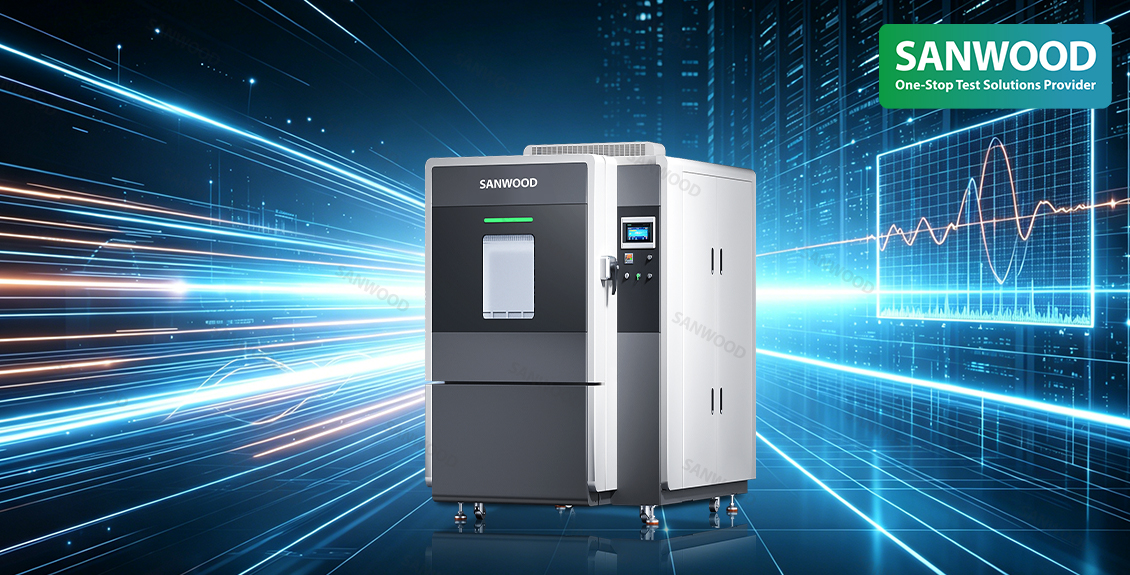
Amid the ongoing upgrade of 100G+ high-speed optical communication systems, the reliability of Electro-Absorption Modulated Lasers (EMLs) under rapid temperature variations directly impacts transmission performance. As a critical optical component, the behavior of EMLs under dynamic thermal stress is essential to overall system stability. Sanwood's Rapid-Rate Temperature Change Chambers fully comply with IEC 60068-2-14:2023 (Environmental Testing – Part 2-14: Test Nb: Change of Temperature), enabling precise identification and evaluation of temperature-induced failure mechanisms in EML chips, and providing optical module manufacturers with professional, compliant and high reliability testing solutions.
Key Challenges
As hybrid devices integrating DFB lasers and EAM modulators, EMLs are highly sensitive to temperature gradients. Under the rapid temperature change conditions defined by IEC 60068-2-14:2023, three primary failure modes are typically observed:
Electrical Parameter Drift: At temperature ramp rates ≥20°C/min, pyroelectric effects and variations in carrier mobility can cause bias drift ≥0.5V, causing the DC operating point to deviate beyond the locking range and directly resulting in eye diagram closure.
Optical Performance Degradation: The extinction ratio may degrade to ≤8 dB, falling below the minimum demodulation threshold for 100G PAM4 signals; Meanwhile, modulation bandwidth also decreases concurrently, with pronounced attenuation of high-frequency components.
Long-Term Reliability Degradation: The combination effects of elevated temperature and rapid thermal cycling accelerates quantum efficiency degradation and junction temperature buildup, exacerbating material fatigue and significantly reducing operational lifetime, particularly beyond 1,000 hours of continuous operation.
Standard Overview
IEC 60068-2-14:2023 (Environmental Testing – Part 2-14: Test Nb: Change of Temperature) is the latest international standard issued by the International Electrotechnical Commission (IEC) for evaluating the ability of components and equipment to withstand temperature variations. The standard places particular emphasis on thermal-mechanical stress induced by rapid temperature changes at heterogeneous material interfaces (such as Au/Sn solder joints and InP substrate-to-heat sink interfaces), which are the primary drivers of package cracking and wire bond fatigue in EML devices.
Solution
To address the above technical challenges, Sanwood's Rapid-Rate Temperature Change Chambers provide the following key capabilities:
Temperature range: -70℃ to +180℃
Humidity range: 20.0% RH to 98.0% RH
Humidity fluctuation: ±2.0% RH
Temperature fluctuation: ±0.5℃ (under no-load, steady-state conditions)
Temperature ramp rate: 5℃/min to 30℃/min
Leveraging these capabilities, optical module manufacturers can conduct rapid temperature change validation of EML chips in accordance with IEC 60068-2-14:2023. This enables quantitative evaluation and screening of devices with stable bias characteristics and compliant eye diagram performance, ensuring the reliability of 100G+ high-speed transmission at the source. Additionally, it provides critical data support for thermal management optimization and structural design improvements.
IEC 60068-2-14:2023 serves as a key benchmark for rapid temperature change testing of communication-grade EML chips. Build around this standard, Sanwood's Rapid-Rate Temperature Change Chambers accurately simulate harsh thermal conditions, supporting both performance validation and reliability enhancement of EML devices.
In addition, Sanwood offers a comprehensive portfolio of advanced environmental test equipment—including HAST Chambers, Thermal Shock Test Chambers, and AGREE Test Chambers—supporting the optical communication industry in overcoming thermal reliability challenges and accelerating the stable mass production and deployment of 100G+ and higher-speed optical modules.
For professional testing solutions, please feel free to contact Sanwood.
Sanwood is not just a company; it is a commitment to delivering high-quality products that stand the test of time.

 English
 中 文
中 文


 info@sanwood.com